
Taiyuan's nature hides in two ridge lines outside town. The southwest runs along spurs of the Lüliang: the Tianlongshan and Longshan grottoes face each other across a valley, the Mengshan Great Buddha sits by a stream, and a Tang-dynasty crypt hides deep in Taishan's courts; the northern line adds Juwei and Erlong mountains, ablaze with foliage each autumn.
The three days alternate hill and water: grottoes and mountain roads first, the great Buddha and lakeside second, red leaves and river valley last. Public transport thins on mountain routes, so mix taxis with buses; temperature swings hard in the hills, so check the summit forecast before setting out.
Itinerary at a glance
| Day 1 · 08:30 | Tianlongshan Grottoes: Buddhas First on the Mountain Road |
| Day 1 · 13:30 | Longshan Grottoes: The Rare Daoist Cave Set |
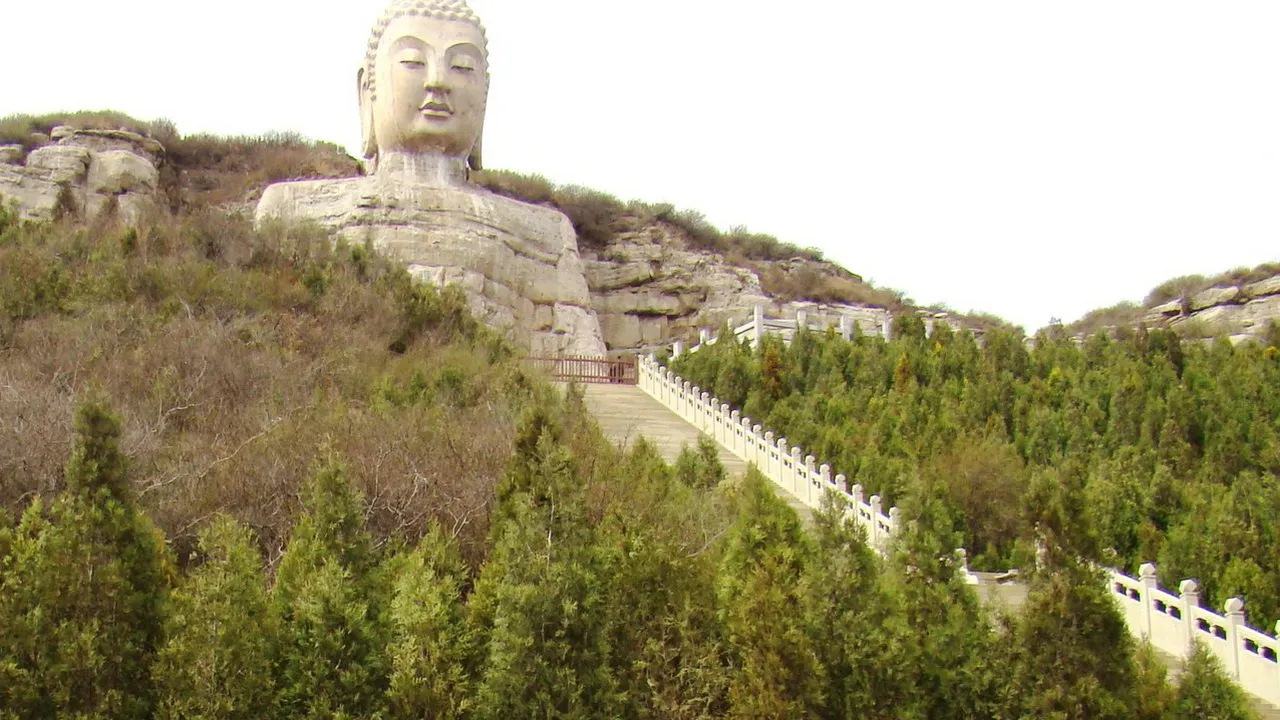
| Day 2 · 08:30 | The Mengshan Great Buddha: A Morning by the Stream |
| Day 2 · 13:30 | Taishan Longquan Temple: The Tang Crypt and Its Golden Coffin |
| Day 2 · 16:30 | Jinyang Lake Park: Sunset on North China's Largest Man-Made Lake |
| Day 3 · 08:30 | Juwei Mountain and Duofu Temple: The Red-Leaf Stage of Taiyuan's Eight Scenes |
| Day 3 · 11:30 | The Dou Dafu Shrine: A Yuan-Dynasty Offering Hall beneath Lieshi Hill |
| Day 3 · 14:30 | Erlong Mountain: A Short Ridge Trail over the Fen Reservoir |
| Day 3 · 17:00 | The Fen Riverside: A Water-Borne Close to Three Hill Days |
The route, stop by stop
Tianlongshan Grottoes: Buddhas First on the Mountain Road
The opening stone of the circuit. Cut from the Eastern Wei through the Tang, Tianlongshan's figures are prized for flowing lines and calm poses; the Northern Qi Buddha head of Cave 8, back from nearly a century abroad, now displays in the gallery near its original home.
Boardwalks link the caves of the eastern and western peaks, about ninety minutes for the main niches. Morning light rakes the cliff face and sharpens every drapery fold, so photographers should budget generously here.
Longshan Grottoes: The Rare Daoist Cave Set
Down from Tianlongshan and north, the top of Longshan keeps something entirely different: Yuan-dynasty Daoist caves, the largest surviving Daoist grotto complex in China, built under the Quanzhen adept Song Defang.
The niches carve Daoist patriarchs and Quanzhen masters; the coffered ceiling of the Xuhuang niche and the reclining figure's calm reward the longest looks. The plain, sturdy style contrasts sharply with Buddhist splendor, making the two mountains one perfect comparative lesson.
The Mengshan Great Buddha: A Morning by the Stream
Carved in the Northern Qi Tianbao era directly from the cliff, the Mengshan Great Buddha rises over sixty meters including its restored head, begun a century before Leshan's. At the morning worship platform, the upper body emerges from river mist, grandeur and stillness at once.
The approach trail climbs along a stream that turns smoke-tree red in autumn. The temple area also keeps the paired Northern Song Lianli towers, a twin form rare in North China, worth ten extra minutes.
Taishan Longquan Temple: The Tang Crypt and Its Golden Coffin
Taishan sits just east of Mengshan, its Longquan temple courts rising tier by tier with the slope. In 2008 excavations here brought up a Tang reliquary of golden coffin within silver casket, now displayed in a purpose-built shelter, echoing the crypt of Famen Temple near Xi'an.
The axis climb takes about twenty minutes, with covered walks and a bell pavilion as rest points. From the top, Jinyang Lake and the western hills line up in one view, among the finest lookouts on Taiyuan's western ridge.
Jinyang Lake Park: Sunset on North China's Largest Man-Made Lake
Jinyang Lake, North China's largest man-made lake, was dug in the 1950s as a power-plant cooling pond and now anchors Taiyuan's biggest waterfront park. Enter from the east shore after 4:30 pm and the water flips the western hills into full reflection.
The lakeshore path runs over ten kilometers, but skip the full loop: the sunset platform and the birding bay are the two essentials. The water shifts blue to gold to grey against Mengshan's outline, the loosest hour of the three days.
Juwei Mountain and Duofu Temple: The Red-Leaf Stage of Taiyuan's Eight Scenes
Day three shifts to the northern hills. Juwei's foliage ranks among Taiyuan's Eight Scenes, the October spectacle of smoke trees setting the whole slope alight. Stone steps climb through the woods, a loop taking about two hours.
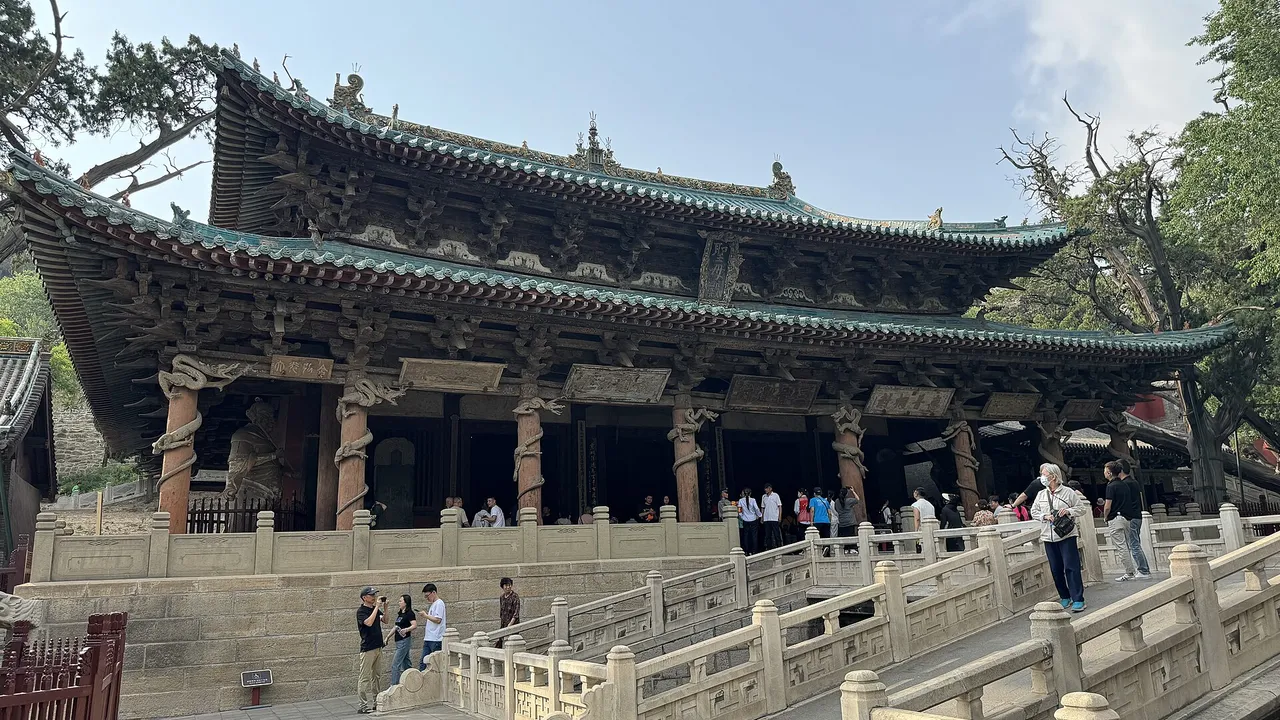
Midway, Duofu Temple preserves Ming murals of the Buddha's life in halls built against the slope, usually near-empty. The old pagoda on the ridge above is the summit landmark, and on clear days the whole Fen valley unfolds from its base.
The Dou Dafu Shrine: A Yuan-Dynasty Offering Hall beneath Lieshi Hill
Descend north to Shanglan village and the shrine to Dou Chou, a Jin-state grandee of the Spring and Autumn era; its Yuan-dynasty offering hall carries an eight-trigram coffered ceiling of such refinement that architecture pilgrims come out of their way for it.
Behind the shrine, the ancient Lieshi cold spring once ranked among Taiyuan's famous waters, shaded by old cypresses. A small but choice stop at forty minutes, timed perfectly for a farmhouse lunch at the village mouth.
Erlong Mountain: A Short Ridge Trail over the Fen Reservoir
East of the shrine rises Erlong Mountain at the foot of the North University of China campus. It is a modest hill, an hour round trip on boardwalk and steps, redeemed entirely by the view: the summit platform faces the Fen reservoir spread between the ridges, a weekend secret of local walkers.
Mountain peaches cover the slopes in spring, and autumn borrows Juwei's red. If the morning already emptied your legs, stop at the mid-hill pavilion; the view alone pays for the trip.
The Fen Riverside: A Water-Borne Close to Three Hill Days
Back downtown, hand the third dusk to the Fen. Slip onto the path near Chaicun Bridge, where the river runs wide and boat traffic thin, the sunset warming the towers across the water, a perfect complement to two days of hills.
The wetland boardwalks host geese and ducks in autumn and winter, close enough to watch without a long lens. The circuit closes here: two mountains, two grotto sites, a great Buddha, a lake and a river, one full pass over Taiyuan's bones.
| Getting around |
|
| Budget | Entries and shuttles total about RMB 200-350; with transport and meals, three days run roughly RMB 700-1,000 per person. |
| Best time | Late April-May blossoms and mid-to-late October foliage are the two peaks; winter winds bite, so compress mountain days toward midday. |
FAQs
Must the three days run in this exact order?
No. Days one and two swap freely as long as Mengshan pairs with Taishan and Tianlongshan with Longshan; keep the northern day last, especially in foliage season. On rain, reshuffle the mountain days first, since caves and crypts barely suffer.
What is the least tiring way without a car?
A chartered car at 600-800 yuan a day split four ways is best value; solo, take taxis up the mountain and buses back, with mountain legs at 20-30 yuan each quite bearable. The lake and riverside sit at the urban edge, so bus the finales.
When exactly does the foliage peak?
Taiyuan's peak falls in mid-to-late October, with Juwei tracking the city closely thanks to its modest elevation. The scenic-area account posts a foliage index; wait for it to pass eighty percent, three days late beats a week early.
What gear does the mountain walking need?
Non-slip hiking shoes are the floor, since all three routes stack steps with frost-prone shade in spring and autumn; add a shell or fleece for ridge wind and at least a liter of water. Juwei and Erlong have no supply points, Mengshan and Taishan keep kiosks at the base, and QR payment covers everything, cash hardly needed.