
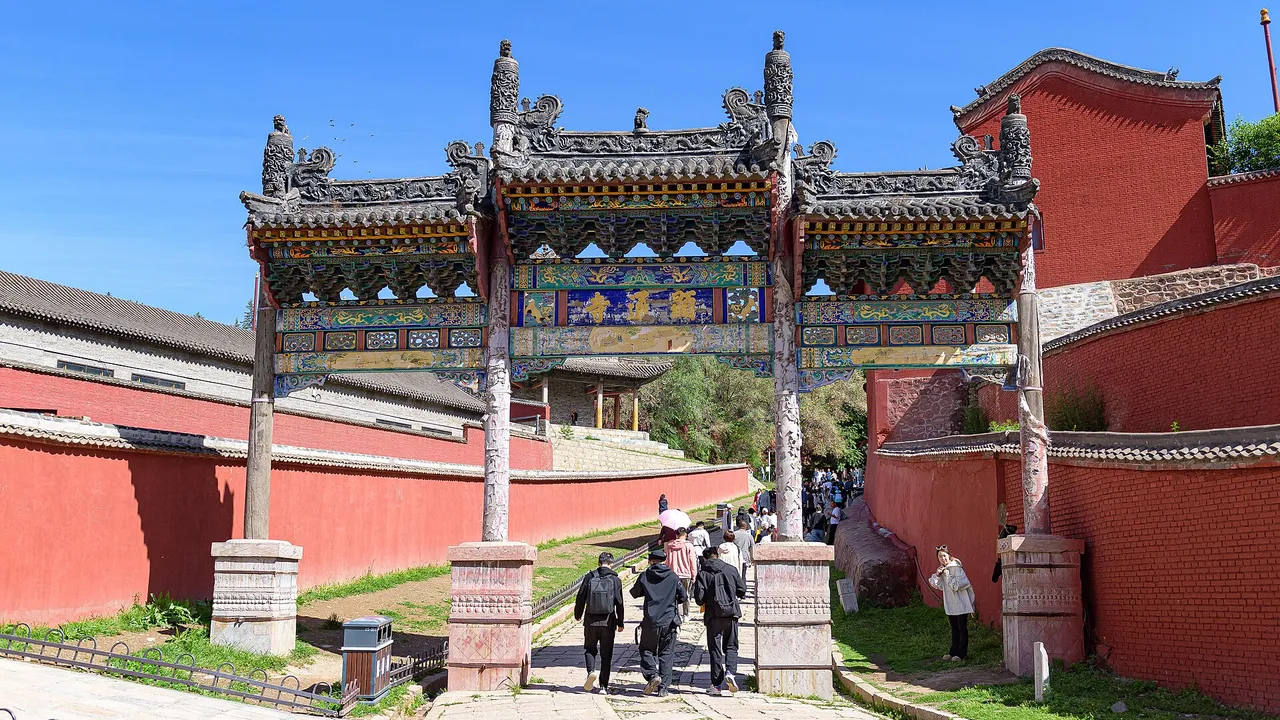
Half the weight of Wutai Shan rests in architectural history. Inside Taihuai, the bronze hall of Xiantong marks the peak of Ming metal casting; outside town, in villages twenty or thirty kilometers away, hide two Tang timber structures that rewrote world architecture: the main hall of Nanchan Temple, raised in 782 and the oldest surviving timber building in China, and the east hall of Foguang Temple of 857, field-confirmed by Liang Sicheng and Lin Huiyin in 1937, breaking the scholarly verdict that no Tang timber survived in China.
Keep the morning in town for bronze and Tibetan art, then charter out after lunch for the two Tang halls, about an hour to the first. Both stand inside quiet villages with no tourist facilities; bring your own preparation or hire a local guide, and reading up before you go transforms the visit.
Itinerary at a glance
| 08:30 | Xiantong Temple: A Hall Cast in Bronze |
| 10:30 | Luohou Temple: The Mechanism of the Blooming Buddha |
| 13:00 | Nanchan Temple's Great Buddha Hall: The Timber Frame of 782 |
| 16:00 | Foguang Temple's East Hall: Liang Sicheng's Answer |
The route, stop by stop
Xiantong Temple: A Hall Cast in Bronze
The culture line opens at Xiantong's bronze hall. Cast entire in bronze, reportedly from one hundred thousand catties of metal, its four walls packed with small Buddhas, every column, beam, window and tile formed in a single casting, a unique survival of Ming foundry art. Before it stand two thirteen-story bronze pagodas engraved with Buddhas and sutras, their bells sounding together in the wind.
The layout itself is a history of the mountain: from the Han origin through Ming and Qing expansion, seven courtyards stepping upward, where Han Buddhist ritual took its settled form. Understand Xiantong and every later temple gains its frame of reference.
Luohou Temple: The Mechanism of the Blooming Buddha
Luohou Temple takes its name from Rahula, son of the Buddha; its fame rests on the Blooming Buddha, a tall carved eight-petal lotus holding a Buddha in each petal, the petals slowly unfurling when ground-level mechanisms turn, revealing the figure at the heart. Driven by a hidden wheel below, it fuses Qing Tibetan Buddhist art with mechanical wit.
Time your visit to a demonstration, usually in the morning and subject to the temple's same-day arrangement. While waiting, study the rest: Tibetan polychrome, a Kangxi imperial plaque, stone lions before the halls, all bearing the mark of an imperial sanctuary.
Nanchan Temple's Great Buddha Hall: The Timber Frame of 782
Nanchan sits some twenty kilometers southwest of Taihuai in Lijiazhuang village; its Great Buddha Hall was rebuilt in 782, making it the oldest surviving timber building in China, seventy-five years older than Foguang's east hall. Three bays wide with deep eaves and a gentle roof pitch, it uses not a single metal nail, every joint a mortise-and-tenon embrace; from the front the whole logic of Tang engineering reads at a glance.
Its seventeen Tang clay sculptures are contemporaneous with the frame, the flanking bodhisattvas full-bodied with flowing drapery, original works barely retouched in later centuries. The hall is small and the yard hushed; half an hour suffices, but give the roof five full minutes from the threshold.
Foguang Temple's East Hall: Liang Sicheng's Answer
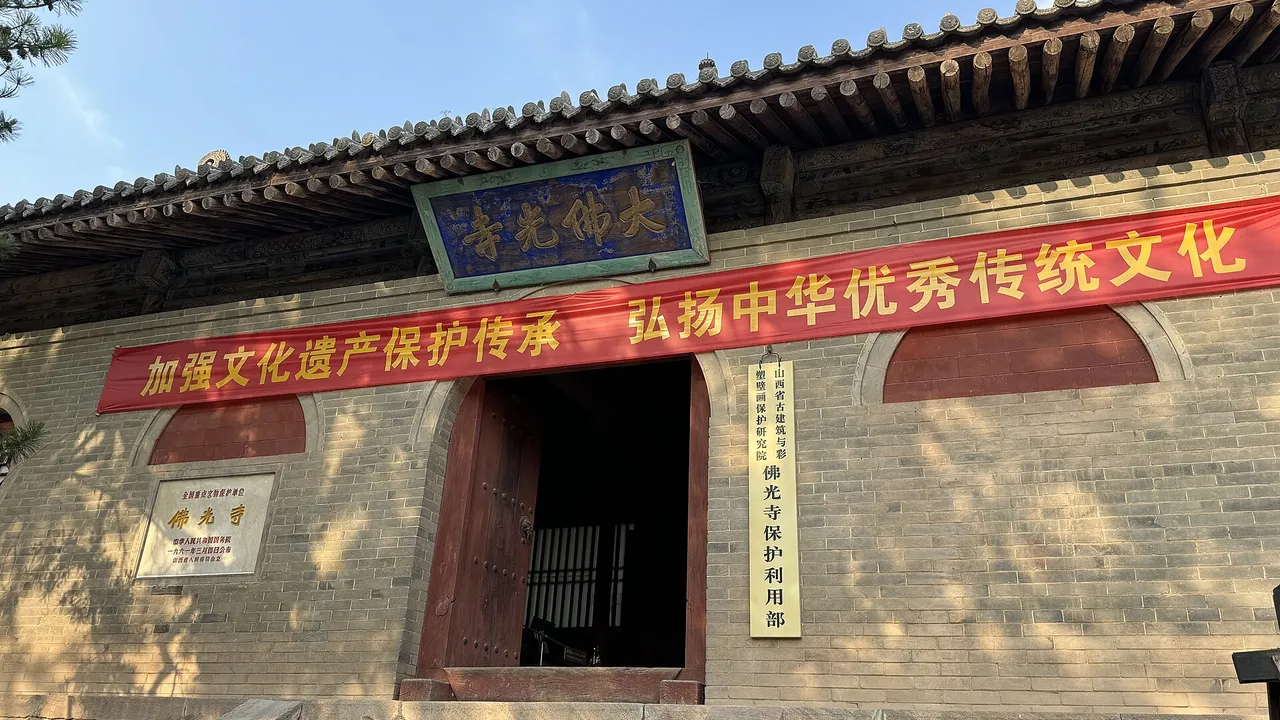
Foguang Temple stands in Foguang village of Douzhen township; in 1937 Liang Sicheng and Lin Huiyin rode mules into these hills and confirmed in one hall a fourfold survival, Tang timber, Tang sculpture, Tang murals and Tang inscriptions, earning the east hall the title of first national treasure of China. The hall is massive, its bracket sets reaching half the height of the columns, Tang grandeur in the flesh.
Before climbing the terrace into the east hall, study the Tang stone pillar at the foot, engraved with the construction date, the ironclad evidence of dating. Tang inscriptions and murals ride the roof beams, visible only by borrowed light; standing in the dim hall beneath timbers untouched for a millennium closes the whole culture line.
| Getting around |
|
| Budget | Temple coupons total about RMB 30, a chartered round trip out of the valley RMB 400-600 (shareable by four), and meals RMB 80-120 pp; roughly RMB 250-350 pp, excluding the RMB 135 mountain entry. |
| Best time | April-June and September-October keep valley roads most reliable; in winter the Nanchan and Foguang roads can ice over, so confirm conditions before setting out. |
FAQs
How do I reach Nanchang and Foguang temples?
Both temples sit in villages over twenty kilometers from Taihuai with thin scenic-bus coverage; the easiest way is a charter with waiting time for about RMB 400-600, shareable by four. Travelers coming from the rail-station side can reach Douzhen township first and hire locally, though services are sparse, so chartering remains the norm.
Do the two Tang halls need tickets or reservations?
Nanchan and Foguang are currently free with no online booking; door opening follows on-site arrangements, sometimes requiring the keeper. The Wutai Shan mountain entry ticket still applies at RMB 135 in season; photography is banned inside the halls, which generally open between nine and five.
Are four temples in one day too rushed?
The pace holds: two town temples in the morning at an hour each, two Tang halls after lunch at forty minutes each, linked by car. The real cost is transit and waiting for doors, so compress lunch to half an hour and leave town by 1:30 pm to return comfortably before dark. If the Tang sculptures fascinate you, drop Luohou from the morning.
What preparation helps before seeing the Tang halls?
Remember at least three things: the dates and status of the two halls, what nail-free mortise-and-tenon means, and the story of Liang Sicheng's 1937 confirmation of Foguang. On-site signage is thin, so read an architecture-history chapter beforehand or hire an inexpensive local guide. The halls are dim; a small flashlight helps greatly for reading the beam inscriptions.