
Three days is the honest unit for depth at Wutai Shan: one for the core temple cluster of Taihuai, one for the mini pilgrimage and the town's ring of monasteries, one out of the valley for Tang timber. The order traces the mountain's own history, from the Han founding temple to Qing imperial grandeur to Tang physical evidence, a living history of mountain Buddhism in three reads.
Two buffers are deliberate: the afternoon's Bishan and Puhua are unhurried places where dawdling is the point, and day three's quiet villages give room to digest. Keep one lodging in central Taihuai throughout and skip the luggage shuffle entirely.
Itinerary at a glance
| Day 1 · 08:30 | Xiantong Temple: Starting the Read in the Eastern Han |
| Day 1 · 10:00 | Tayuan and Wuye Temples: The Great Stupa and the Incense Center |
| Day 1 · 14:00 | Luohou Temple: Tibetan Halls and the Blooming Buddha |
| Day 1 · 16:00 | Pusa Ding: Closing the Day in Imperial Scale |
| Day 2 · 08:30 | Shuxiang Temple: The Great Image at Manjushri's Home |
| Day 2 · 10:00 | Dailuoding: The Mini Pilgrimage of 1080 Steps |
| Day 2 · 14:00 | Bishan Temple: The Quiet of a Ten-Directions Monastery |
| Day 2 · 16:00 | Puhua Temple: A Blended Close |
| Day 3 · 09:00 | Nanchan Temple: China's Oldest Surviving Timber Hall |
| Day 3 · 11:00 | Foguang Temple: The Discovery of Liang and Lin |
The route, stop by stop
Xiantong Temple: Starting the Read in the Eastern Han
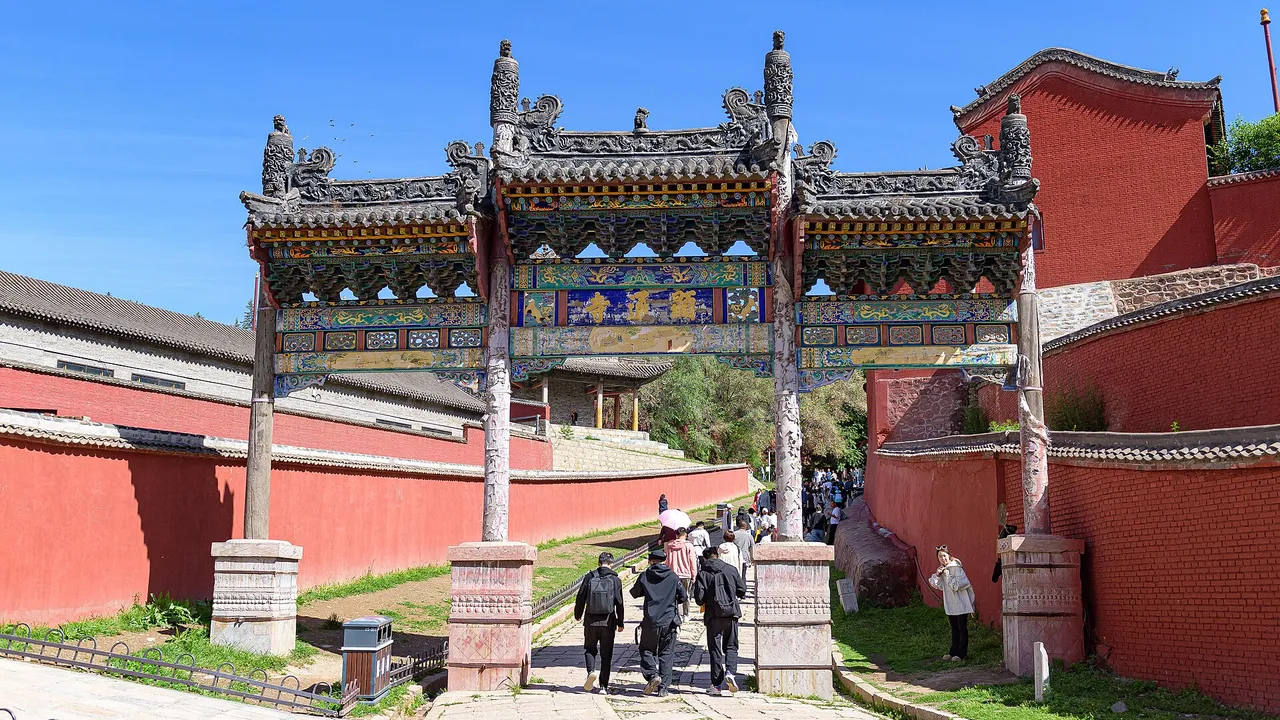
Begin the three days at Xiantong, where the mountain's story starts. Founded in the Eastern Han, it marks Manjushri's arrival in these hills, and successive dynasties added courts so that seven courtyards now lay out nineteen centuries of building in sequence. Walking the Manjushri hall, the brick Wuliang Hall and the bronze hall walks the dynasty timeline itself.
Note the paired bronze pagodas before the bronze hall and the thousand Buddhas inside; Ming casting detail reads best in morning light. At the exit, glance back at the Qing-rebuilt gate, whose era gap with the halls proves the mountain never stopped growing.
Tayuan and Wuye Temples: The Great Stupa and the Incense Center
Tayuan was originally the stupa court of Xiantong before becoming independent in the Ming; its Great White Stupa rises over fifty meters in whitewashed plaster, the spiritual axis of the whole mountain. The stupa enshrines relics of the Buddha, and hundreds of bronze bells hung on its body carry the wind across half the town.
Circumambulation is the standard act here, pilgrims circling clockwise past the prayer wheels ringing the base. Come off the hour: tour groups move by the clock, and half an hour's offset leaves the court to the bells alone.
A few steps away sits Wuye Temple, the most fervent petition spot on the mountain, its front censer never cold, with the opera stage where singing for the Fifth Lord repays vows. Use the temple's eco incense and offer this one on the way, and the morning's line completes itself.
Luohou Temple: Tibetan Halls and the Blooming Buddha
Give the afternoon to Luohou, one of the mountain's five great monasteries and the Tibetan Buddhist stronghold of Taihuai. Its signature is the Blooming Buddha, an eight-petal carved lotus each petal holding a Buddha, petals opening and figures appearing as the mechanism turns, a Qing craftsman's conceit still running.
The layout departs visibly from Han monasteries, side halls housing Tibetan figures under richly painted colors. When legs tire, sit on the courtyard steps as afternoon sun slants into the red walls, the quietest stretch of the whole three days.
Pusa Ding: Closing the Day in Imperial Scale
Close day one on Pusa Ding, where the 108 steps end at the highest-ranking Tibetan Buddhist temple on the mountain, a Qing imperial lodge on pilgrimage. Tricolor glazed roofs, stone steps and stele pavilions built to imperial scale; from the terrace at dusk, the town's stupa and temple roofs merge into one sweep.
If evening services run, chanting and ritual instruments rise together inside; ten minutes under the eaves is the best footnote to why emperors kept endowing this mountain.
Shuxiang Temple: The Great Image at Manjushri's Home
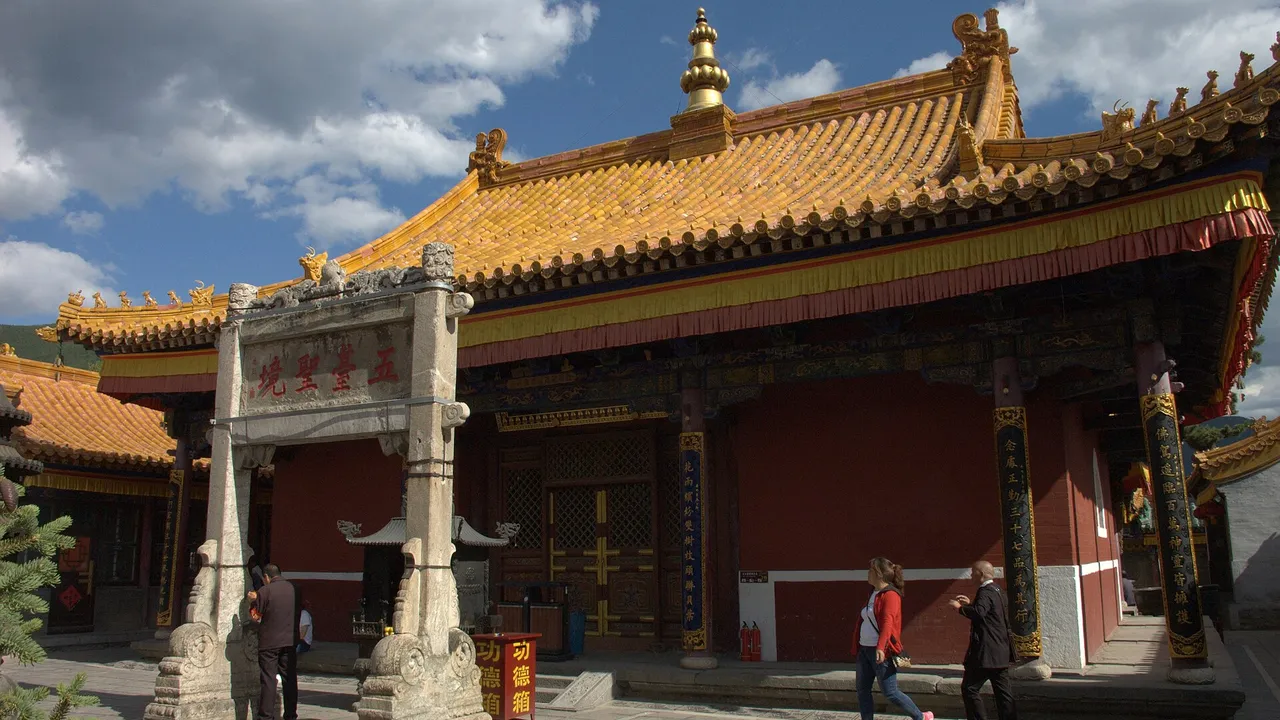
Day two inverts the first: south first before crowds wake, with Shuxiang Temple opening the morning. The Manjushri pavilion holds a striding-lion image near ten meters tall, the largest on the mountain, the beast planting four feet and turning its head, sculptors folding motion into stillness.
Along both walls, five hundred suspended arhats cling to the plaster, their depth shifting with your position; standing at the hall's center and turning slowly amounts to a three-dimensional exhibition of ancient sculpture.
Dailuoding: The Mini Pilgrimage of 1080 Steps
Give the morning's strength peak to Dailuoding. Dazhi Road's 1080 stone steps wind upward, pilgrims bowing every three steps or counting aloud, ordinary visitors reaching the top in forty minutes to an hour. The summit hall gathers the five terrace Manjushri figures in one place, so one climb counts as the mini pilgrimage.
The Dailuoding cableway skips the steps in minutes, with walking reserved for the descent. The summit view is superb, the five terraces lining up on clear days, the only chance in three days to take all five silhouettes at once.
Bishan Temple: The Quiet of a Ten-Directions Monastery
Slow the afternoon deliberately, opening at Bishan, the largest ten-directions monastery on the mountain, which hosts wandering monks free of charge. The temple sits in green shade north of town, its gate plain and courtyards broad, visitors few, the best place in three days simply to be still.
The ordination hall and its white marble platform are the highlights; if monks chant, listen from outside. Free of commerce and commentary, the daily texture of monastic life shows most truly at Bishan.
Puhua Temple: A Blended Close
Day two closes at Puhua by the Qingshui River south of town. Its gateway and screen wall are the mountain's showpiece of blended Han and Tibetan ornament, brick carving dense yet ordered, and the Republican-era restoration gives it a period temperament unlike any other temple here.
By evening Puhua is nearly empty, halls so still in the slant light you can hear the eave bells. Walk back along the river to town and stop there, saving the legs for day three's trip out of the valley.
Nanchan Temple: China's Oldest Surviving Timber Hall
Day three charters out of the valley, first stop Nanchan. Its Great Buddha Hall was rebuilt in 782, the oldest surviving timber building in China, standing for over twelve hundred years without a single nail, held up purely by joinery and the balance of posts and beams.
The seventeen Tang sculptures are contemporaneous with the hall, their drapery and expressions original works. The village is quiet, wind moving through the cypresses across the forecourt, a world apart from the incense clamor of Taihuai.
Foguang Temple: The Discovery of Liang and Lin
The finale goes to Foguang. In 1937 Liang Sicheng and Lin Huiyin followed clues from Dunhuang murals to this village and confirmed the east hall as a survival of 857, unique in holding Tang timber, sculpture, murals and inscriptions together, hence its title as the first national treasure of China.
As you climb the terrace to the hall, look up at the brackets, their size near half the column height the signature of Tang work. Inside is dim, and a flashlight picks the Tang inscriptions off the beams; finding the line Lin Huiyin read aloud that year is the finest close to the whole journey.
| Getting around |
|
| Budget | Entry RMB 135, temple coupons about RMB 60 in all, Dailuoding cableway around RMB 80 return, valley charter about RMB 500; roughly RMB 600-900 pp over three days. |
| Best time | May-June and September-October suit best, quiet temples and open summits; July-August is pilgrimage high season, so start at dawn to stay ahead. |
FAQs
Where is the best base for three days?
Stay put in central Taihuai: the first two days run entirely on foot, and day three's charter picks up from town. Guesthouses toward the rail station sit far from the core temples and cost time morning and night; peak-season central rooms go fast, so book an inn with breakfast at least a week ahead.
Do temple coupons and cableway tickets need advance purchase?
Coupons pay on site, a few to ten yuan each, no booking needed. The Dailuoding cableway queues hard in season, so buy online ahead or catch the first car before eight. The RMB 135 mountain entry is mandatory; buy it real-name via official online channels, since walk-up purchases waste an hour or two at peak.
Are two Tang halls worth a dedicated day?
Yes. Nanchan and Foguang are unique-grade physical evidence of Chinese architectural history, irreplaceable by any temple in town, and the quiet villages offer a register wholly different from the town's incense. With only two days, compress Foguang into a half-day return, but never drop Nanchan; the oldest hall always takes priority.
What fitness does the three-day plan demand?
Average fitness suffices: day one around fifteen thousand steps, day two about twenty thousand including the Dailuoding climb, day three mostly by car. Short on stamina, ride the cableway both ways and save legs for the afternoon. With big day-night temperature swings, a hot foot soak each evening speeds recovery.