
Five days is the unhurried version of Wutai Shan: no forced trek, no squeezed category of sights. Two days go deep on the core temples of Taihuai, day three charters to the North Terrace's roof of North China and the South Terrace meadows, day four exits the valley for Nanchan and Foguang, and day five closes on the quiet of Bishan and Longquan.
The logic gives each experience its own full day: incense and architecture in town, summits and meadows on high, history and village life beyond. Every afternoon holds a blank slot, so rest at the inn when tired; five days pass without overdraft, and leaving feels reluctant.
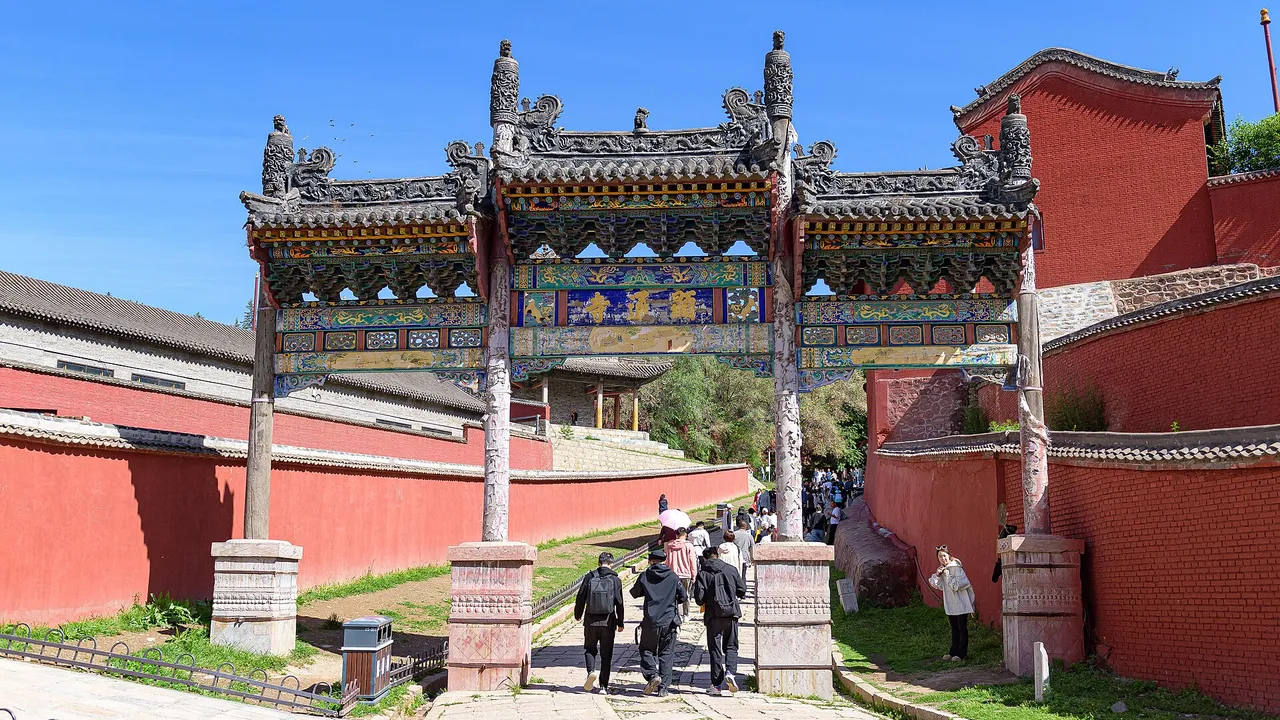
Itinerary at a glance
| Day 1 · 08:30 | Xiantong Temple: Entering the Story at the Founding Temple |
| Day 1 · 11:00 | Tayuan and Wuye Temples: The Circle and the Wish |
| Day 1 · 14:00 | Pusa Ding and Luohou Temple: Imperial Scale and Tibetan Halls |
| Day 2 · 08:30 | Shuxiang Temple: The Great Image of Manjushri's Home |
| Day 2 · 10:30 | Dailuoding: The Mini Pilgrimage of 1080 Steps |
| Day 3 · 08:00 | Chartered Terraces, First Half: East and North |
| Day 3 · 13:30 | Chartered Terraces, Second Half: Central, West and South |
| Day 4 · 09:00 | Nanchan Temple: The Oldest Surviving Timber Hall |
| Day 4 · 11:30 | Foguang Temple: The Discovery of Liang and Lin |
| Day 5 · 09:00 | Bishan Temple: A Quiet Morning at a Ten-Directions Monastery |
| Day 5 · 11:00 | Longquan Temple: Closing at the Carved Gateway |
The route, stop by stop
Xiantong Temple: Entering the Story at the Founding Temple
Five days open at Xiantong, where the mountain's timeline begins: Han founding, dynasties of additions, the Ming bronze hall, Qing scale, seven courtyards stacked by era. Spend the morning slowly, fixing each hall's date and story, and every sight across the next four days gains its frame of reference.
The bronze hall and pagodas own the morning, the brick Wuliang Hall the connoisseur's subplot. First visits need not be greedy; remember the dates of three objects and the mountain stops being a heap of similar halls.
Tayuan and Wuye Temples: The Circle and the Wish
Flow straight from Xiantong into Tayuan, circling the Great White Stupa clockwise three laps and spinning the prayer wheels one by one. Wuye Temple stands next door, queues still short before eleven, the right hour for incense and wishes. These two are the incense heart of the mountain; seeing it first anchors every later temple.
Wrap by midday and return to your inn to eat, dodging the noon crowd peak. Give the afternoon to Pusa Ding, which catches the best viewing light as the sun leans west.
Pusa Ding and Luohou Temple: Imperial Scale and Tibetan Halls
Climb Pusa Ding in the afternoon, imperial glazed roofs at the top of 108 steps, the terrace holding the town's finest panorama of stupa and temple roofs. Descend into Luohou for the Blooming Buddha and Tibetan painting; one Han, one Tibetan, the pair forms a field lesson in the mountain's twin lineages.
Return to the center by dusk and stroll the Qingshui after dinner. Day one logs some fifteen thousand steps, so sleep early; Dailuoding tomorrow wants fresh legs.
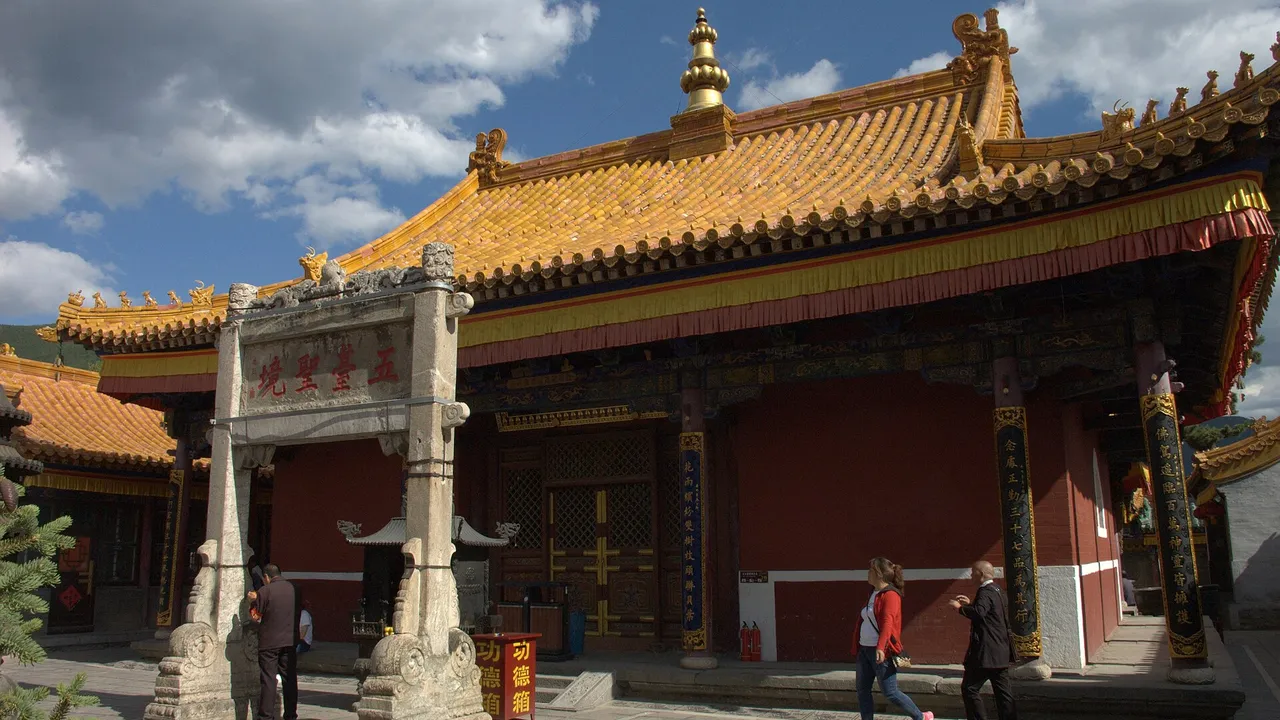
Shuxiang Temple: The Great Image of Manjushri's Home
Day two opens at Shuxiang in the quiet of morning, facing the near-ten-meter striding-lion Manjushri and the five hundred suspended arhats. Stand at the hall's center and turn slowly, expressions and depths shifting with every angle, the summit of the mountain's sculptural craft, worth twenty minutes of nothing else.
Breakfast after at the stalls outside, liveliest around seven. The morning keeps just one temple by design, saving strength for Dailuoding's 1080 steps.
Dailuoding: The Mini Pilgrimage of 1080 Steps
Set off at half past ten for Dailuoding, climbing Dazhi Road's 1080 steps, forty minutes to an hour at a normal pace. The summit hall gathers the five terrace Manjushri figures in one place, and on clear days the five silhouettes line the horizon, the mini pilgrimage made visible.
Ride the cableway down to spare the knees, then take the blank afternoon back at the inn. Day three charters the terraces, so tonight check shell jacket, bottle and sunscreen; half the drive runs above two thousand meters.
Chartered Terraces, First Half: East and North
Day three skips the trek and charters the summit road for the distilled grand circuit. Morning reaches Dongtai's Wanghai Peak for the cloud sea, then Beitai's Yedou Peak to stand on the 3061-meter roof of North China. Road touring trades away fifty kilometers of walking and not one view of the five terraces.
Summit wind bites and temperatures run ten degrees under town, forty minutes to an hour per stop, dressing and undressing briskly at each. Drivers know the best photo angles; a polite ask saves an hour of wandering.
Chartered Terraces, Second Half: Central, West and South
The afternoon runs Zhongtai's boulder field, then the gentle meadow of Xitai, closing at Nantai's Jinxiu Peak. Summer wildflowers peak here, and the open ground before the temple is the loosest of the five terraces, where the day lands naturally.
The drive back to Taihuai takes an hour or so, arriving in time for dinner. A road day spends no steps but altitude and wind still drain, so sleep early before the hard valley run tomorrow.
Nanchan Temple: The Oldest Surviving Timber Hall
Day four charters out of the valley, Nanchan first. Its Great Buddha Hall of 782 is the oldest surviving timber building in China, standing over twelve hundred years on nail-free joinery, its seventeen Tang sculptures contemporaneous. The village is quiet, wind audible across the forecourt.
The key to a Tang hall is structure: the eaves, brackets and the load logic of the frame. Read ten minutes beforehand and the visit transforms; these two halls carry the densest two hours of knowledge in five days.
Foguang Temple: The Discovery of Liang and Lin
Reach Foguang around midday, where in 1937 Liang Sicheng and Lin Huiyin confirmed the east hall as a survival of 857, holding Tang timber, sculpture, murals and inscriptions together, hence the title of first national treasure. Climbing to read the brackets and entering with a flashlight to read the beam inscriptions are both unskippable.
The Jin-dynasty Manjushri hall and steles reward extra time if you have it. Return to Taihuai by three or four, in time for an afternoon nap before dinner.
Bishan Temple: A Quiet Morning at a Ten-Directions Monastery
The last day sets no targets, opening with the hush of Bishan. The largest ten-directions monastery on the mountain hosts monks from anywhere, courtyards broad and visitors few, the white marble ordination platform the highlight. Free of commerce and commentary, monastic daily life shows most truly here.
Stone benches under old trees invite stillness; if monks chant, listen a few minutes from outside. By now the five days have slowed your rhythm to the mountain's own frequency.
Longquan Temple: Closing at the Carved Gateway
The final stop goes to Longquan, closing the journey at the Republican stone gateway, its brackets and dragons assembled block by block, half an hour of study without a repeat panel. Stone carving is the most overlooked chapter of the mountain's architecture, best saved for last to complete the previous four days.
Wash your face at the spring beside the temple, take a last bowl of terrace-mushroom noodles in town, and leave generous transfer time for the afternoon train. Five days at Wutai Shan, complete.
| Getting around |
|
| Budget | Entry RMB 135, coupons about RMB 70 in all, Dailuoding cableway around RMB 80, charters for terraces and valley about RMB 900-1100; roughly RMB 1500-2500 pp across five days. |
| Best time | May-June and September-October optimize everything: summits open, temples uncrowded, valley roads to the Tang halls stable. |
FAQs
Which day of the five is the hardest?
Day three, the terrace day, spends no steps but altitude and wind cost more than most expect, often leaving you more spent than a trekking day. Timed stops, brisk layering and a full lunch manage it. Day four runs long but soft, so the two sit adjacent by design yet keep day three's evening completely free of plans.
Charter or trek for the terraces?
It depends on purpose: for the views of all five summits, a chartered day covers everything, saving strength and dodging weather windows; for the felt completion of pilgrimage, two to three days on foot is irreplaceable. This five-day plan charters because the town temples and Tang halls already claim the legs; ordinary travelers rarely get both, so do not force it.
What does the five-day plan cost per person?
Excluding long-haul transport, budget roughly fifteen hundred to twenty-five hundred: entry 135, coupons and cableway near 150, two charter days about 250 split by four, lodging across five nights spanning hostel to inn, and fifty to a hundred a day on food. Season gaps land mostly on lodging, so early booking saves a quarter or more.
Is five days realistic with seniors or children?
Realistic with small edits: cableway both ways at Dailuoding, merge or trim the terrace and valley days to one, keep Bishan and Shuxiang as flat-ground family stops. Steps and queues tire children most, so start early, carry snacks and warm layers, and the blank afternoon each day exists for them.