
Chengde earns three days if all three are spent where it counts. Day one owns the whole Mountain Resort: palaces and lakes in the morning, hill and plain zones in the afternoon, with the Wenjin Pavilion's complete library copy and the grassland tones of the Ten Thousand Tree Park as the afternoon's peak. The lake, hill and plain zones each carry their own character; only walking the whole garden explains why an emperor moved Jiangnan, steppe and mountain inside one wall.
Day two goes all-in on the outer temples: Puning and Pule in the morning, Putuo Zongcheng and Xumifushou in the afternoon, with the ticket math settled in advance. Day three slows: climb Qingchui Peak for the city panorama, add Anyuan Temple as the outer temples' final corner, and close with the Chengde Museum and the Rehe Confucian Temple. Nothing rushed, nothing wasted.
Itinerary at a glance
| Day1 · 08:30 | Resort Palaces and Lakes: The First Two Hours |
| Day1 · 13:30 | Resort Hill and Plain Zones: Wenjin Pavilion and the Ten Thousand Tree Park |
| Day2 · 08:30 | Puning Temple: Overture to the Outer Temples |
| Day2 · 10:30 | Pule Temple: The Mandala of the Xuguang Pavilion |
| Day2 · 14:00 | Putuo Zongcheng Temple: The Red Terraces in the Afternoon |
| Day2 · 16:30 | Xumifushou Temple: The Panchen's Golden Roofs |
| Day3 · 08:30 | Qingchui Peak: The City from Above |
| Day3 · 11:00 | Anyuan Temple: The Outer Temples' Last Corner |
| Day3 · 14:00 | Chengde Museum: Three Days in Review |
| Day3 · 16:30 | Rehe Confucian Temple: The Sound of Books Beyond the Wall |
The route, stop by stop
Resort Palaces and Lakes: The First Two Hours
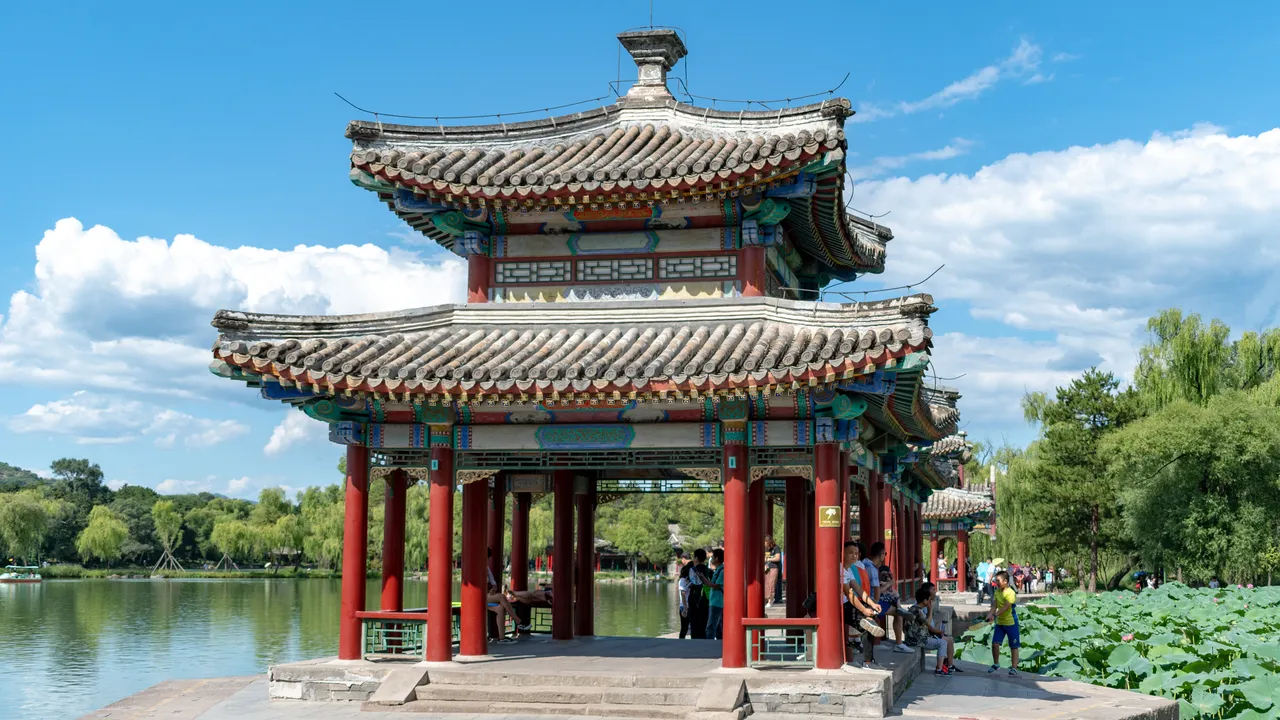
Step through the gate at opening. Walk the palace axis, the Frugality and Honor hall, the Four Knowledge Study and the Mist and Waves hall, the nanmu fragrance sharpest in morning air. After an hour pivot into the lakes, where the Zhijing cloud dike parts the water and Ruyi Isle, the Misty Rain Tower and the Golden Hill pavilion string along it, while the Rehe Spring steams unfrozen in the northeast corner.
The right morning move is walking the dikes slowly, not taking a boat; the shifting shore angles are the design's whole point. From the Water Heart Pavilion bridge, the layered recession of water and buildings was measured by two generations of Kangxi and Qianlong craftsmen. These two hours set your verdict on Chengde.
Resort Hill and Plain Zones: Wenjin Pavilion and the Ten Thousand Tree Park
Give the afternoon to the two-thirds most visitors skip. Ride the hill shuttle to the Clouds on All Sides pavilion; the hill zone is no nameplate, holding four-fifths of the garden, and from the summit Sledgehammer Peak lies north and the town south, the whole siting logic laid bare. Descend into the plain zone, where the Ten Thousand Tree Park once hosted feasts for Mongol princes and deer still move through the trees.
At the plain's west end stands Wenjin Pavilion, one of the three imperial libraries housing the Complete Library of the Four Treasuries; the pool before it plays with light, a stone aperture folding a false crescent moon into the water, the designers' buried easter egg. Crowds thin to nothing here, afternoon light sifting through birch and old pines, the quietest hours of the three days.
Puning Temple: Overture to the Outer Temples
Day two starts with one of the compound's founding principals. Puning's Han-front, Tibetan-rear layout is the key to the whole group: the Qing built beyond the wall under the maxim of ruling through local faith without forcing custom, temples addressed to Mongol and Tibetan believers, and to history.
The thousand-armed Guanyin reads best in morning side light; from the platform behind, the resort's hill silhouette lies across the Rehe River, the two complexes' facing geometry complete. The on-site exhibition details the Dzungar campaigns and the temple's cause and effect, skippable when pressed, since the museum tells it more systematically.
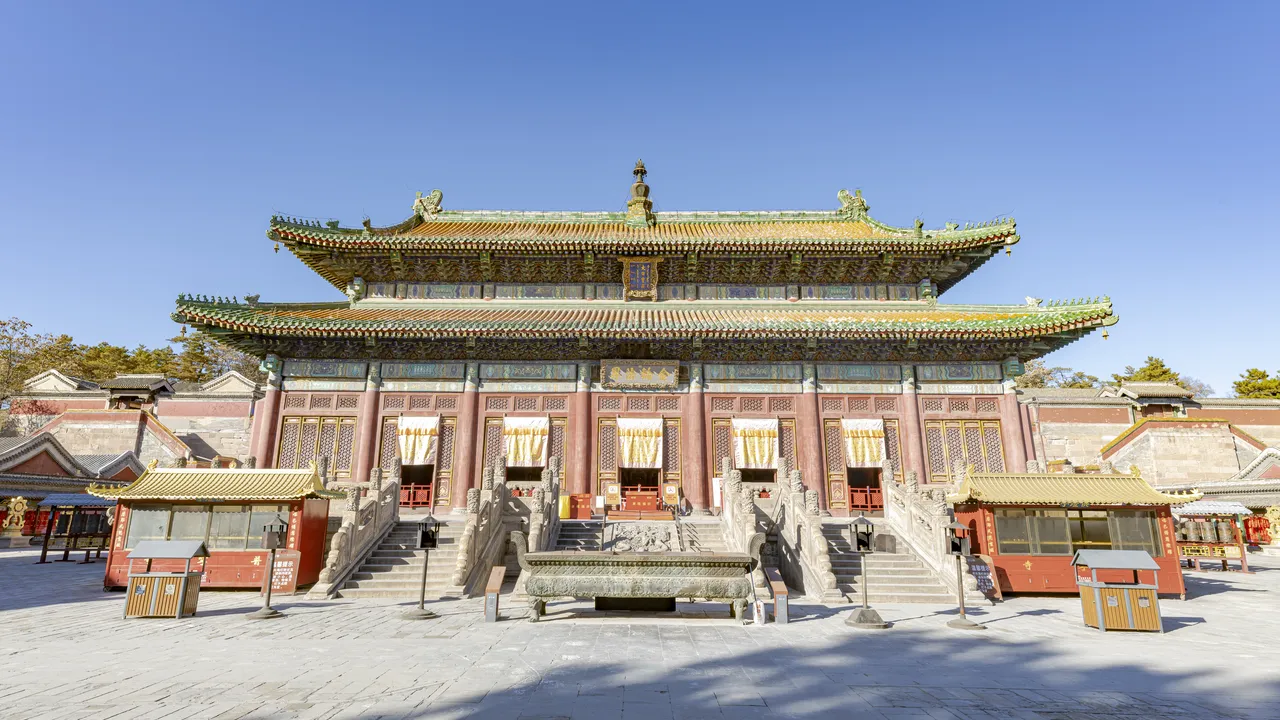
Pule Temple: The Mandala of the Xuguang Pavilion
Pule is the least visited of the outer temples, and thus the most rewarding. Built to house submitting Kazakh and Bulut nobles, its front half is Han-style while the rear Xuguang Pavilion wears a double-eaved dome, its dragon-and-phoenix caisson ceiling and bronze mandala model the textbook survival of Qing esoteric architecture, the gilded dragons still bright.
The stone balustrades before the pavilion and the view back to Sledgehammer Peak form a designed tableau: stand at the door's exact center and the rock locks into the frame. The temple is small, forty minutes, but photographers overstay happily.
Putuo Zongcheng Temple: The Red Terraces in the Afternoon
The afternoon's main course is the group's largest, Putuo Zongcheng. The Potala-style red terraces crown the hill, white buildings rising tier by tier beneath, and the slanting afternoon light pushes the red to full saturation. The Wanfa Guiyi Hall hides at the terraces' core, its gilded fish-scale copper roof visible whole only from the top platform.
The ascent out-dramatizes the hall: gate houses, narrow lanes between white terraces, the grade steepening until the summit opens onto the resort and town below. The stele pavilion for the Torghut return stands before the terraces; read it first, and history locks onto the view.
Xumifushou Temple: The Panchen's Golden Roofs
The combo's second half lies a few hundred meters on. When the Sixth Panchen Lama traveled east for Qianlong's seventieth birthday, the court raised this residence copying Tashilhunpo, built in barely over a year, the fastest of the outer temples. The double-eaved golden-tile roof of the Miaogao Zhuangyan Hall carries eight gilded dragons, each in a different pose, the most extravagant roof in the whole group.
Dusk light sets the gold alight, which is exactly why the slot sits here. The terraces run more restrained than Putuo Zongcheng and walk easier, and the Jixiang Faxi Hall's upper floor surveys the whole temple. Half an hour before closing the crowds drain, the best window for the golden roofs.
Qingchui Peak: The City from Above
Day three opens with a climb. The cableway lifts you in a quarter hour to the viewing deck, the chime-stone column close enough to read its weathered crown, the finest spot to understand how the summit's form was carved. Resort, outer temples and the Rehe valley all fold into one frame, your three days of routes re-typeset at a glance.
Strong walkers go up on foot through the forest park's birch and oak, the grade mostly gentle. On the descent the cliff carvings of Baoshan Temple deserve a pause, Qing-era figures resting quiet in the rock.
Anyuan Temple: The Outer Temples' Last Corner
Descending from Qingchui Peak you pass Anyuan Temple, built to resettle the Dashidava Mongols from the Ili valley and modeled on the Guelza temple there, its black roof unique among the outer temples. The grounds once hosted military reviews and imperial feasts, and the layout keeps the open air of a parade ground.
Visitors usually stop at Puning and the two Tibetan-style giants, leaving Anyuan quiet beyond belief. The Green Tara legend and the destruction of the original Guelza temple lend the black roofs a faint elegy. Forty minutes completes the political map of the outer temples.
Chengde Museum: Three Days in Review
Placing the museum on the last afternoon turns it into a review. The palace nanmu, the logic of architectural quotation, the Torghut return, the Panchen's journey, each has a gallery unit, and three days of site memory get re-filed systematically. The construction-history wing explains garden techniques the grounds left cryptic.
The Qing arms, costume and Mongol-Tibetan artifact galleries run underrated; seeing the objects, the ceremonies before the halls acquire body heat. Two hours, then the Rehe Confucian Temple waits nearby for a digesting stroll.
Rehe Confucian Temple: The Sound of Books Beyond the Wall
Ending at the Confucian temple is deliberate: the outer temples spoke Tibetan Buddhist politics, the temple spoke Confucian order, the emperor's two hands beyond the wall both written in buildings. The Dacheng Hall's rank, the imperially inscribed steles, and the history of Rehe's examination halls complete the summer capital's other half.
At dusk the temple empties of visitors, cypresses and yellow tiles resting in the last light. Walk back through the old streets afterward, pick up a fresh rose paste at Erxianju, and three days of Chengde close pleasantly in the stomach.
| Getting around |
|
| Budget | Three days of tickets run about RMB 450-550 pp (resort two-day or dual entry, each temple and the combo), with meals and lodging about RMB 900-1300. |
| Best time | May-Jun and Sep-Oct suit best; in season enter the resort at opening, take the temples off-peak afternoons, and keep the three days breathable. |
FAQs
Are three days enough for the resort and all the outer temples?
Yes, with slack: a full day for the resort, one for the four principal temples, and day three still breathes with the peak, Anyuan and the museums. The only cut is in the hill zone, shuttle or walking, never both; spend the saved hour at Wenjin Pavilion and the Ten Thousand Tree Park, where the resort's real depth lives.
How do I combine combo and single tickets across the outer temples?
Buy the official Putuo Zongcheng plus Xumifushou combo, a clearly sold pairing; Puning, Pule and Anyuan sell separately. If all five are on the list, ask on site about multi-temple passes, usually saving twenty to thirty percent; for three temples, the combo plus one single is already optimal.
Is one day across all three resort zones too tiring?
Demanding but manageable: walk the lakes in the morning, take the hill shuttle, walk the plain zone, keeping the day near fifteen thousand steps. The real killer is walking the hill zone, long grades with poor returns. An hour on a bench in the Ten Thousand Tree Park transforms the second half.
Which of the three days most rewards an early start?
Day one. The first hour in the palace quarter is the trip's quietest frame, morning light and hall keepers alone under nanmu, and the lakes' mist and reflections peak before nine. Puning Temple on day two also pays for early arrival, its morning aura wholly different from afternoon, though the delta is smaller.