
Seven days is Chengde's complete answer because the city layers thickly: days one to three belong to emperors, the resort's three zones and the temple cluster a standing archive of Qing frontier politics; day four belongs to the city itself, museum, Confucian temple, old streets and riverbank; days five to seven belong to geography, Jinshanling's wall, Saihan's forest, Yudaokou's steppe, tracing the whole transition from the Yan Mountains toward Inner Mongolia.
The luxury of a week is slowness: two days for the resort, three for the temples, two nights on the plateau. Nothing rushes and every dusk has a seat. The single discipline is booking early, above all the plateau and wall-footing nights, where beds in season outsell tickets in difficulty.
Itinerary at a glance
| Day1 · 08:30 | The Palace Quarter: The Week's Overture |
| Day1 · 14:30 | The Lakes and the Rehe Spring: Finishing the Water |
| Day2 · 08:30 | Hill and Plain Zones: Day Two's Depth |
| Day2 · 15:00 | Chengde Museum: Reading the Resort as History |
| Day3 · 08:30 | Puning Temple: The Buddha in Morning Light |
| Day3 · 10:30 | Pule Temple: Caisson and Tableau |
| Day3 · 14:00 | Putuo Zongcheng: The Red Terraces in Full |
| Day3 · 16:30 | Xumifushou: The Golden Roof Finale |
| Day4 · 08:30 | Qingchui Peak and Baoshan Temple: A Morning of Height and Carvings |
| Day4 · 14:00 | Anyuan Temple and the Confucian Temple: Two Final Pieces |
| Day5 · 09:00 | Jinshanling Great Wall: Zhuanduokou to General Tower |
| Day6 · 10:00 | Saihan: The Forest Sea and Seven Star Lake |
| Day7 · 08:30 | Yudaokou and the Road Home: The Steppe Coda |
The route, stop by stop
The Palace Quarter: The Week's Overture
Starting the week in the palace quarter is the first move of the whole board. The nanmu of the Frugality and Honor hall, the Four Knowledge Study, the Mist and Waves hall, one axis hour that decides how much of the next six days you can read: everything in Chengde footnotes the question of why emperors came beyond the wall.
Skip the lakes this afternoon and study the quarter's side galleries instead: clocks, hanging screens and porcelain in period settings. Half the resort on day one, the rhythm slowed, is how a week keeps its legs.
The Lakes and the Rehe Spring: Finishing the Water
The afternoon circles the lakes counterclockwise: the Zhijing dike, the Water Heart Pavilion, Ruyi Isle, the Misty Rain Tower, closing at the Rehe Spring in the northeast. Rehe is the river's name below the welling spring, old gazetteers calling it the shortest river under heaven, unfrozen in winter; one spring, one river, one province's former name.
Evening light flatters the water best, the Golden Hill pavilion and Sledgehammer Peak sharing the frame. Dine around Dehui Gate and walk the greenway outside the wall to digest, day one ending at the riverbank.
Hill and Plain Zones: Day Two's Depth
Day two completes the resort's remaining two-thirds. The shuttle climbs to the hill zone, stopping at the Clouds on All Sides pavilion and Green Maple Islet, Sledgehammer north and the town south; descend on foot through the plain, the Ten Thousand Tree Park, the old horse-testing ground, ending at Wenjin Pavilion where stone light folds a false moon into the pool.
Two days hand you all three zones' characters: the palaces' ritual, the lakes' grace, the hills' wildness, the plain's breadth. Most visitors crush this into half a day and call Chengde nothing much; a day and a half takes it apart properly.
Chengde Museum: Reading the Resort as History
Mid-afternoon suits the museum: the resort's garden craft, construction history and political function unfold systematically, every model and map clicking onto a site memory. The autumn-hunt gallery draws the route map for the days heading north.
The Qing Mongol-Tibetan artifacts and temple architectural members deserve slow reading, a preview of the outer temples' prototypes and logic of quotation before you stand in them. Two hours, then the old streets still hold dinner.
Puning Temple: The Buddha in Morning Light
Day three enters the outer temples' home ground. Enter Puning at opening, the front Han courtyard solemn, the rear Great Vehicle Pavilion copying Samye, the twenty-meter thousand-armed Guanyin catching layered morning side light in its carved robes. From the rear platform the resort's hills lie across the river.
The on-site exhibit lands the Dzungar-and-temple causality, museum knowledge from two days ago taking root. Two slow hours, lunch in the nearby blocks, since the afternoon's two giants cost legs.
Pule Temple: Caisson and Tableau
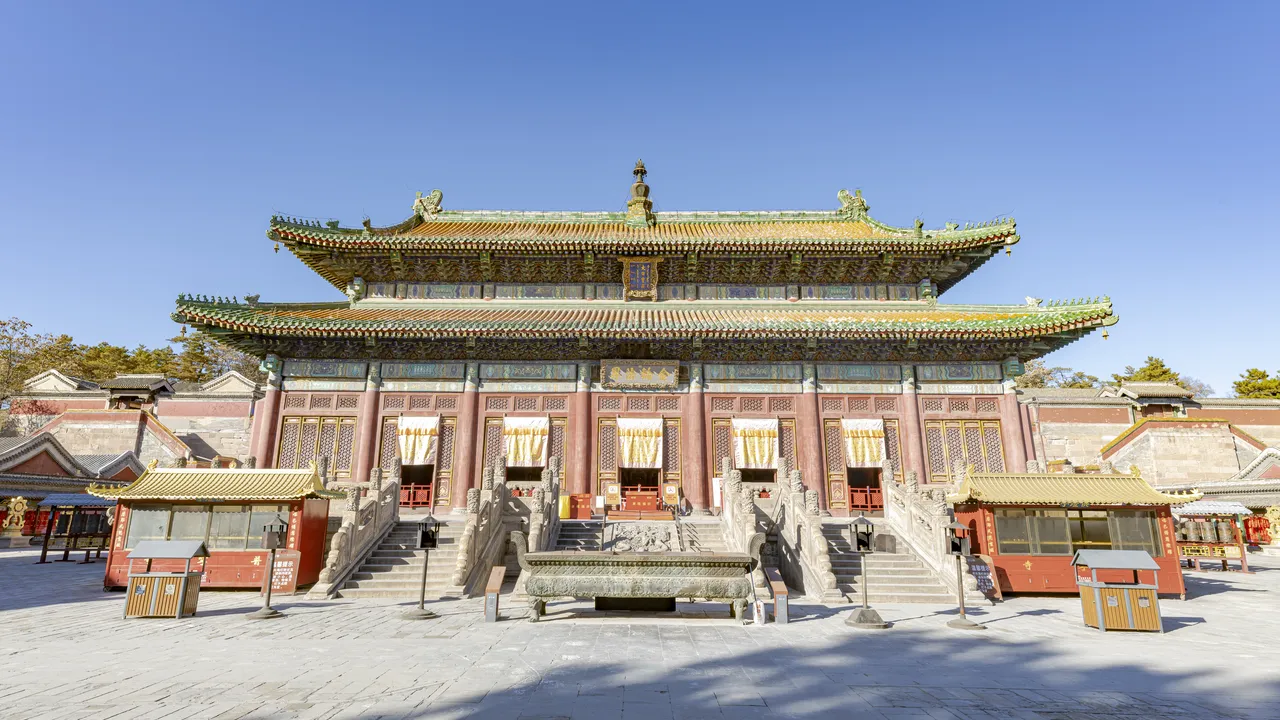
At half past ten shift to the quietest temple, Pule. The dragon-and-phoenix caisson under the Xuguang Pavilion's double dome keeps its gilding intact, the bronze mandala at center a standing model of Qing esoteric cosmology, ten minutes of looking up well spent. From the doorway's dead center, Sledgehammer Peak locks into the frame, the compound's most delicate designed tableau.
Forty minutes finishes Pule and banks time for the afternoon; ten taxi minutes bridge the temples, lunch back near the resort before noon.
Putuo Zongcheng: The Red Terraces in Full
Give the afternoon whole to Putuo Zongcheng. Climb the Potala-style terraces slowly: gate houses, lanes between white buildings, the grade steepening until the top opens with the gilded Wanfa Guiyi roof and the whole resort spread together. The Torghut stele pavilion stands before the gate; read before climbing.
Afternoon reddens the walls and thickens the tours, so enter before two and take the right-hand steps. Linger on top, where the city's landmarks lie assembled below.
Xumifushou: The Golden Roof Finale
The combo's second half sits a few hundred meters on, the Sixth Panchen Lama's residence. Eight gilded dragons coil the golden double eaves of the Miaogao Zhuangyan Hall and catch fire in evening light, the single best frame of all three temple days. The Jixiang Faxi Hall's second floor surveys the temple, its terraces more restrained than Putuo's.
The last half hour before closing empties out; walk slowly. The main road returns downtown, dinner in the old town, the outer temples' grand run closing here.
Qingchui Peak and Baoshan Temple: A Morning of Height and Carvings
Day four's morning climbs. From the deck the chime-stone column reads its three hundred million years of weathering up close, resort and temples re-typeset below into one map. Descend through the forest park's tracks to Baoshan Temple, Qing craftsmen's cliff Buddhas seated in the rock, worth the pause.
The morning turns the skyline into a personal reference point: on the plateau or at the wall afterward, this is the column you will miss. Lunch on wood-stove dishes at a foothill farmhouse.
Anyuan Temple and the Confucian Temple: Two Final Pieces
The afternoon fits the last pieces of both the temples' line and the Confucian one. Anyuan's black roofs stand alone, built for the resettled Dashidava Mongols copying Ili's Guelza temple, its Green Tara story tinged with elegy. The Rehe Confucian Temple then anchors frontier learning, the Dacheng Hall and imperial steles speaking the other philosophy of rule.
One Tibetan, one Confucian, two stops, and both of the Qing's hands in Chengde lie open. Walk back along the Rehe at dusk, dinner in the old town, early night before tomorrow's wall.
Jinshanling Great Wall: Zhuanduokou to General Tower
Day five leaves downtown, ninety charter minutes to Jinshanling. One of the nation's best-preserved original stretches, watchtowers, barrier walls and battle platforms stud the ridge; enter at Zhuanduokou heading west, General Tower and the West Five-Eye dealing postcards all the way. Three hours round trip on honest grades, protect knees and camera alike.
Morning cloud seas visit often, likeliest after rain clearing. Check into a village farmhouse at the foot, wood-stove dinner, and bank strength for the northern run.
Saihan: The Forest Sea and Seven Star Lake
Day six crosses the plateau, starting at the forest-farm exhibition: three generations planting a desert into a million-mu forest, the instruction manual for every Bashang view after. Enter the park by noon, the Saihan tower reading the unbroken green horizon, the afternoon given to Seven Star Lake, a Big Dipper of boardwalks over wetland.
Evening settles in the forest-farm town over iron-pot stew and oat noodles. In late September, golden birch against the water is the week's annual frame; after dark the town's edge shows the Milky Way, Bashang's sky charging nothing.
Yudaokou and the Road Home: The Steppe Coda
The last morning belongs to Moon Lake: mirror water, cattle drinking at the rim, globe flowers banking the shore June through August. One circuit, then the Luan source, the boardwalk's end seeping a sea-reaching river's first water. Midday starts the grassland highway home, cloud shadows crawling the slopes, herds holding right of way.
Back in Chengde by evening, seven days from resort to frontier, garden to steppe, close cleanly here. Same-evening trains or next-day departures both fit, a hot old-town noodle bowl archiving the week in the stomach.
| Getting around |
|
| Budget | Tickets total about RMB 800-900 pp, a two-to-three-day charter RMB 600-900, seven nights RMB 1400-2200; the week runs roughly RMB 3200-4500 per person. |
| Best time | Jun-Sep carries the whole week, late September's plateau gold the year's peak; in season hit the resort and temples at opening and keep wall walks off noon. |
FAQs
What really separates seven days from five?
The gap is rhythm, not count: seven days split the resort into a day and a half, the temples into two, sleep two nights on the plateau, and still keep a night under the wall. Five is the standard answer, seven the close-reading edition; if time or budget pinches, five loses mainly the plateau's ease.
What must a seven-day plan give up?
Not sights so much as the urge to hit everything: Pule and Anyuan can be quick stamps, the hill zone shuttle-assisted, and on the plateau pick two or three minor sights. Bank legs and hours for the four true peaks, the palace quarter, the red terraces, Jinshanling and Seven Star Lake; the rest are supporting cast.
How do I book seven nights in season most safely?
The rule: the remoter, the earlier. Plateau farm-town and Ulan Butong beds sell out first, lock them a week ahead; Jinshanling farmhouses next; downtown Chengde forgives booking two or three days out. Confirm breakfast-dinner inclusion and heating everywhere, plateau nights are no joke.
Is seven days feasible with seniors along?
Feasible with subtraction: shuttle or cableway for the hill zone and Qingchui Peak, judge the red-terrace climb honestly, keep Jinshanling to the first half from Zhuanduokou, and slow the two plateau days. Fortunately downtown clusters tight with cheap taxis, so only three of the seven days run hard, and seniors hold that line.