
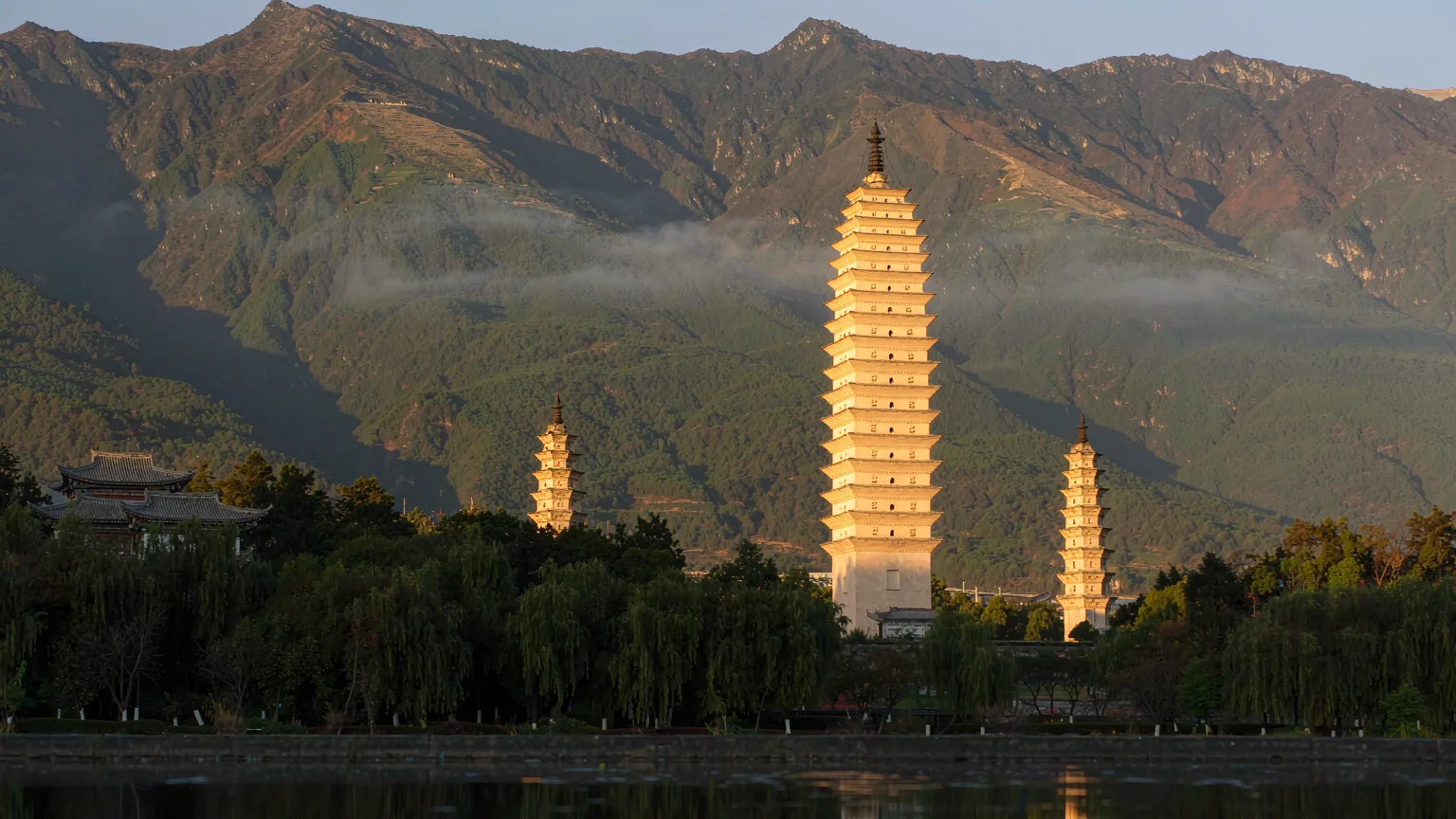
A day in Dali should follow the light: the old town before the crowds, when the flagstones stay cool and shops are just unlocking, is walking at its best; by midday the sun sits over the Cangshan range, and from the Three Pagodas the towers and the ridge share one frame, the classic Dali photograph.
Give the afternoon to Xizhou, where wheat and rice fields trade colors with the seasons and the courtyard houses hold every rule of Bai architecture. Return to the lakeshore for dusk. Dali's sunsets need no luck, only an early claim on the water's edge, twenty minutes ahead. Buses and taxis link everything; no charter needed.

Itinerary at a glance
| 08:30 | Dali Ancient City: Fuxing Road in the Morning |
| 10:30 | Three Pagodas of Chongsheng Temple: Framed with the Cangshan Range |
| 14:00 | Xizhou Ancient Town: Fields, Courtyards and Baba Flatbread |
| 18:00 | Erhai Park: Closing on a Lakeside Sunset |
The route, stop by stop
Dali Ancient City: Fuxing Road in the Morning
Enter the old town at the north gate and drift south along Fuxing Road. Before nine, the main street belongs to vegetable sellers and residents walking dogs; silver shops lift their shutters and pastry ovens exhale their first batch. Looking back beneath the Wuhua Gate tower, the gate and the Cangshan clouds stack into one frame, the best shutter angle in town.
The lanes off Fuxing Road outlast the main street: the boutiques of Renmin Road and the old cafes of Yangren Street all sit within five minutes on foot. First-timers should finish the main drag, note the lane entrances, and save the alleys for an evening return.
Three Pagodas of Chongsheng Temple: Framed with the Cangshan Range
The three pagodas are Dali's landmark: the Tang-era Qianxun Pagoda flanked by two smaller towers, with the nineteen peaks of Cangshan rising behind. The ordering trick most visitors miss: walk first to the reflection park beside the site and shoot the towers and mountains mirrored whole in the water, then enter the temple and look up from below.
The grounds are broad and electric carts help, but the core pagoda zone is walkable. Two hours suffice: one for the towers and their reflection, one for the Nanzhao Buddhist sculpture inside the halls.
Xizhou Ancient Town: Fields, Courtyards and Baba Flatbread
Twenty-odd minutes north of the pagodas by taxi or minibus sits Xizhou, a Bai town quieter than Dali's old city, with intact clusters of Ming and Qing courtyards. The Yan Family Compound is the grandest, its screen walls, gate towers and woodcarving still tallying the old accounts of the tea-horse merchants. The fields beyond town trade colors with the seasons, wheat green and rice jade in summer, all gold by autumn.
Lunch happens in town: freshly slapped baba flatbread comes sweet with rose sugar or savory with scallion and minced pork, crisp outside and soft within while hot. Afterward walk the field paths; that is how Xizhou is meant to be read.
Erhai Park: Closing on a Lakeside Sunset
Erhai Park spreads over Tuoshan Hill in Xiaguan, the lakeshore closest to Dali Railway Station. From the small summit the lake opens below, the midwater pavilion and the distant Cangshan range drawing one line. After six the light softens, the water burning from gold to violet, Dali's least-effort sunset.
Starting the day from Xiaguan makes this the natural last stop; from the old town, the taxi back after dusk takes about forty minutes, a fine nap on wheels.
| Getting around |
|
| Budget | Pagoda ticket RMB 75, Xizhou courtyards RMB 20-40, with meals and local transport about RMB 150-260 pp. |
| Best time | March-May and September-November are steadiest; summer afternoons bring showers, so start early; Golden Week doubles the old town crowds. |
FAQs
Old town first or pagodas first in one day?
Old town first, pagodas second. The town is quiet with soft light before mid-morning, while the pagodas take their best front light from ten to noon and the reflection park needs windless water, so the timing chains naturally. Reversed, you hit the Xiaguan-to-town morning traffic and the day suffers.
Do pagoda tickets need advance booking, or can I buy on site?
Book online ahead in peak season and scan in to skip the ticket windows; on weekdays on-site sales rarely sell out. E-tickets bind to your passport or ID, so carry the original at the gate. Whether the reflection park bundles with the main ticket follows the same-day notice.
Is one day too tight for old town, pagodas and Xizhou?
Brisk but doable if you cut the secondary: main street only in town, two hours capped at the pagodas, and in Xizhou just the Yan compound plus the fields. To slow down instead, drop Erhai Park, watch sunset from the Xizhou field paths, and head straight to rest.
What practical details matter on a one-day Dali trip?
Three things. Sun protection beats warmth: plateau ultraviolet at noon is fierce, so hat and cream are essential. Cash is nearly obsolete since stalls take QR payments, though small notes help at country stalls. From November through February mornings hover near freezing, so pack a windproof layer and go light after noon.