
Dali's nature is neatly arranged: the Cangshan range west, Erhai east, a fertile plain between. Three days follow that geography. Day one climbs: ride a cableway over the pine forest, eat vegetarian at Jizhao Nunnery, and meet the firs and rhododendrons higher up. Day two descends to the water: cycle the Erhai ecological corridor past wetlands and rice fields at Longkan, Caicun and the Haishe Peninsula.
Day three rounds to the east shore, looking back at Cangshan from Shuanglang, and only then does Erhai earn its name of sea. No checklist sprints here; each day carries one or two anchors and leaves the bulk of hours to the road between. Buses, hired bikes and taxis chain it all; no charter needed.

Itinerary at a glance
| Day 1 · 08:30 | Cangshan Gantong Cableway and Jizhao Nunnery: First Steps Uphill |
| Day 1 · 14:30 | The Erhai Ecological Corridor at Longkan: The Right Way Down |
| Day 1 · 19:30 | Honglongjing, Dali Old Town: Back to the Water at Night |
| Day 2 · 08:30 | Xizhou and Haishe Peninsula: Morning on the Spit |
| Day 2 · 14:30 | Erhai Moon Wetland Park: The Lake's Other Face |
| Day 2 · 18:00 | Caicun Wharf: Fishing Boats and the Day's Last Light |
| Day 3 · 09:00 | Shuanglang: Looking Back at Cangshan from the East Shore |
| Day 3 · 12:30 | Little Putuo: A Miniature Guanyin Shrine Midwater |
| Day 3 · 14:00 | Wase Caixiangyuan: Lunch on the East Shore |
| Day 3 · 17:00 | Erhai Park: The Full Stop of Three Days |
The route, stop by stop
Cangshan Gantong Cableway and Jizhao Nunnery: First Steps Uphill
Nineteen peaks of Cangshan wall in Dali on the west, and of the several cableways the Gantong line suits best: ten minutes up, then a half-hour walk to Jizhao Nunnery, famed as the most artistic convent, its courtyard of succulents and orchids arranged in every tilted pot with care. The vegetarian lunch costs about twenty yuan and queues at mealtime; the house rule takes seconds freely and shames leftovers.
The strong-legged can continue from the nunnery toward Qingbi Stream onto the Yudai cloud path, gentle underfoot, with the whole Dali plain turning below at every look back.
The Erhai Ecological Corridor at Longkan: The Right Way Down
Descend in the afternoon and enter the ecological corridor near Longkan Wharf. This closed lakeside greenway bars motor traffic; hire a bicycle or e-bike and roll slowly, Erhai on one side, rice fields and villages on the other, with the S-bend and the drowned trees the two most photographed spots. After four the light gilds the water and the path visibly empties.
The corridor stretches well past a hundred kilometers, but visitors need only its prime stretch, Longkan to Caicun, some five kilometers, an easy hour and a half of riding.
Honglongjing, Dali Old Town: Back to the Water at Night
Day one closes with no sight at all: dinner back at Honglongjing in the old town. After a cableway and a corridor, sit by the channel, order sour-spicy fish or a mushroom claypot, and let the water sound rinse the day off. At night the lanterns come on and most visitors drain away, the town's best hour.
Afterward walk Fuxing Road slowly home, past the gate towers lit for the night, and call day one done.
Xizhou and Haishe Peninsula: Morning on the Spit
Day two runs north to Xizhou. Breakfast in town, then head straight to Haishe Park southwest of it, a long narrow spit reaching into Erhai, water on three faces, reeds and willows at the waterline, morning mist common and egrets skimming low. The spit's tip is the purest view of the lake, no boardwalk crowds, only wind and water.
Back in town by noon, the Yan Family Compound and the old lanes belong to after lunch, dodging the bare noon sun over the fields.
Erhai Moon Wetland Park: The Lake's Other Face
The afternoon belongs to Erhai Moon Wetland Park near Xiaguan, the largest wetland on the lakeshore. Boardwalks thread through dawn redwood and reed beds; the name honors the moon over Erhai, one of Dali's four famous scenes, its reflection once the pride of local evenings when the sky behaved.
For visitors the draw is ecology: black swans and a roster of waterfowl live year-round on the shallows, and children can learn their water plants. The park stays uncrowded, a fine place to walk the afternoon's fatigue away.
Caicun Wharf: Fishing Boats and the Day's Last Light
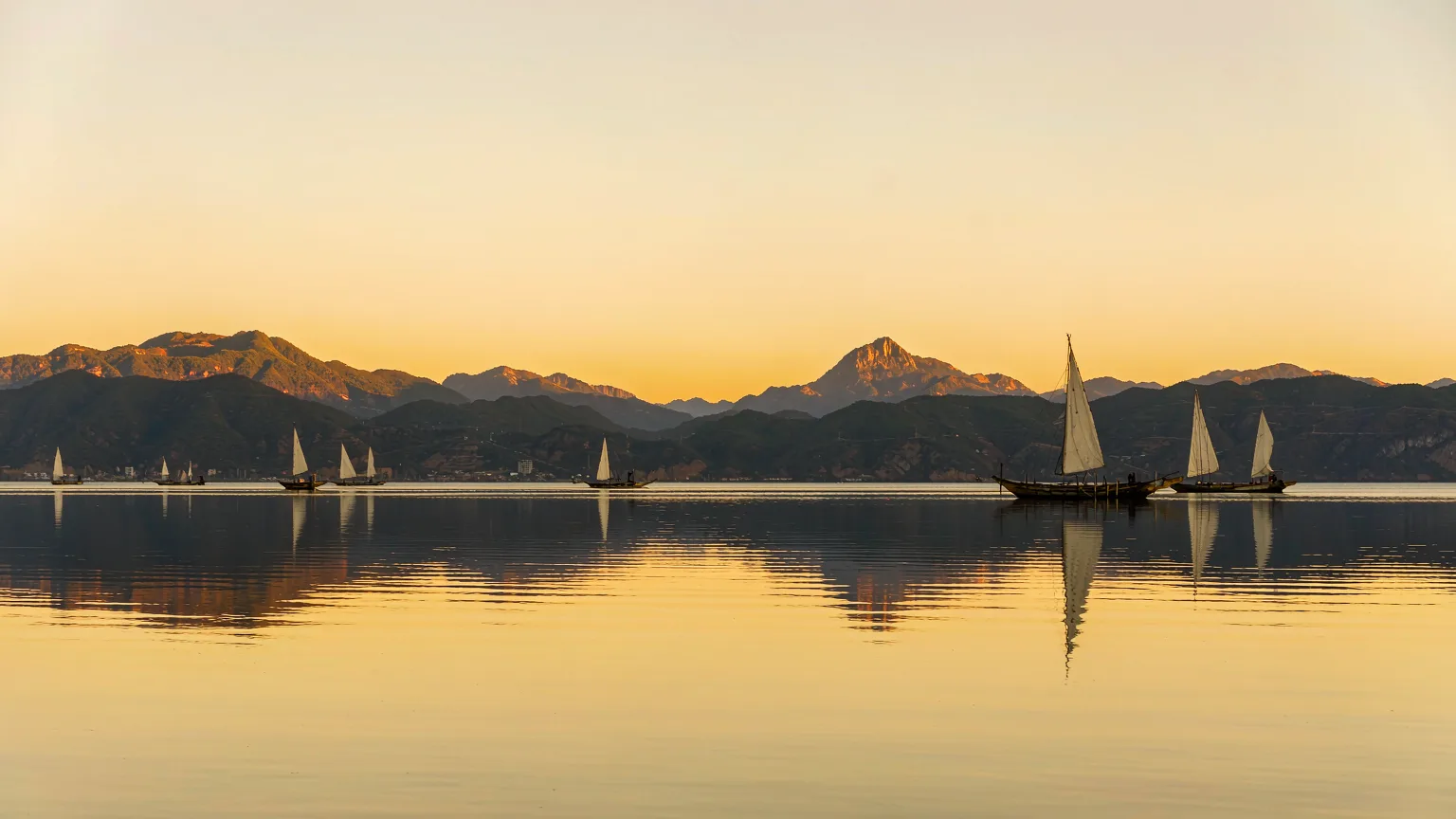
At dusk return to Caicun Wharf, once a fishing village; the boats and mooring posts stayed after the fishing ban, and homeward craft share the frame with the sunset glow. The boardwalk reaches out over the water, and its end is the place to wait for the sun as Cangshan turns silhouette across the lake, day two's easiest finale.
Lakeside eateries cluster in Caicun; dinner at the wharf works well, with local-style sour-spicy fish and seaweed-taro soup both worth an order.
Shuanglang: Looking Back at Cangshan from the East Shore
Day three rounds to the east shore, and Shuanglang is its most settled town, built waterline-tight on Yujii Island and the peninsula lanes. From this shore the nineteen peaks of Cangshan line up whole across Erhai for the first time, the moment many travelers finally grasp Dali's geography. The lanes suit slow wandering, with cafe and inn terraces facing the water.
Shuanglang runs more commercial than the west shore, though tidied up in recent years with a clean lakeside walk. Two hours for lanes and shoreline suffice.
Little Putuo: A Miniature Guanyin Shrine Midwater
Ten-odd minutes south of Shuanglang sits Little Putuo, a Guanyin shrine on a reef barely breaking the surface, islanded at high water and joined by a narrow spit when the lake drops, and in winter adopted by black-headed gulls arrived from Siberia. The shrine itself is tiny; the point is its scale against the lake, like a seal stamped on the water.
The shore platform is the canonical shot; in winter the gull-feeders outnumber the shrine-gazers, bread crumbs fly and shutters rattle.
Wase Caixiangyuan: Lunch on the East Shore
Wase clusters the east shore's fishing-family kitchens, and Caixiangyuan keeps a steady local name. The signatures are lakeside home cooking: sour-spicy fish in the traditional shore recipe, haicai, a water plant gathered from the lake, silken on the tongue, and taro soup simmered dense. Portions run honest; three or four dishes feed two or three people.
After lunch walk Wase Wharf, where the shore stays quieter than Shuanglang and the reefs and shallows suit long-exposure shots.
Erhai Park: The Full Stop of Three Days
Loop back from the east shore to Xiaguan and close at Erhai Park. In three days you have seen Erhai from the mountain, the west shore and the east; from the top of Tuoshan take it in whole at last, water, plain, range and the road behind you, one summarizing view and the right place to say goodbye to the lake.
Dinner in Xiaguan afterward, and either the evening train or next day's flight leaves easily. Three unhurried days close the circle of Dali's nature exactly.
| Getting around |
|
| Budget | Cableways RMB 100-280 by route, bike hire RMB 30-60 a day; three days of meals, beds and transport run about RMB 800-1500 pp. |
| Best time | March-June blooms, September-November bluest skies; in the June-August rains start mountain days early and mind the sun on the lake loop. |
FAQs
Where should I base myself for these three days?
Simplest is two nights in the old town with day three returning straight from the east shore. For lake views, move to Shuanglang or Caicun for night two, forwarding luggage between inns or by taxi. Three changes of beds make work; two or fewer is the sane count.
Is e-biking around the lake safe, and what paperwork applies?
The lake road carries fast traffic and blind bends, so beginners should not e-bike the full loop, while riding inside the corridor is very safe. Rentals need a deposit and ID registration, and helmets are enforced by roadside checks. The sane mix: ride the corridor, ride in a car around the lake.
How do I pick a Cangshan cableway? Do the three differ much?
They differ in height and time. Gantong is the easiest, linking Jizhao Nunnery with the mid-section of the cloud path; Zhonghe sits closest to town; the Ximatan grand cableway climbs highest to a viewing deck near four thousand meters, dearest priced and most weather-dependent. For this three-day plan Gantong fits the rhythm; save Ximatan for a dedicated mountain day.
What should I watch in the rainy season?
June-August rain mostly falls as afternoon showers: schedule mountain and rides for mornings and keep afternoons flexible indoors. Mountain paths slicken, cableways halt in wind and heavy rain, so keep a plan B. A light raincoat beats an umbrella, unmanageable against wind on a bike. And after rain the light often turns superb, so never cancel for a drizzle.