
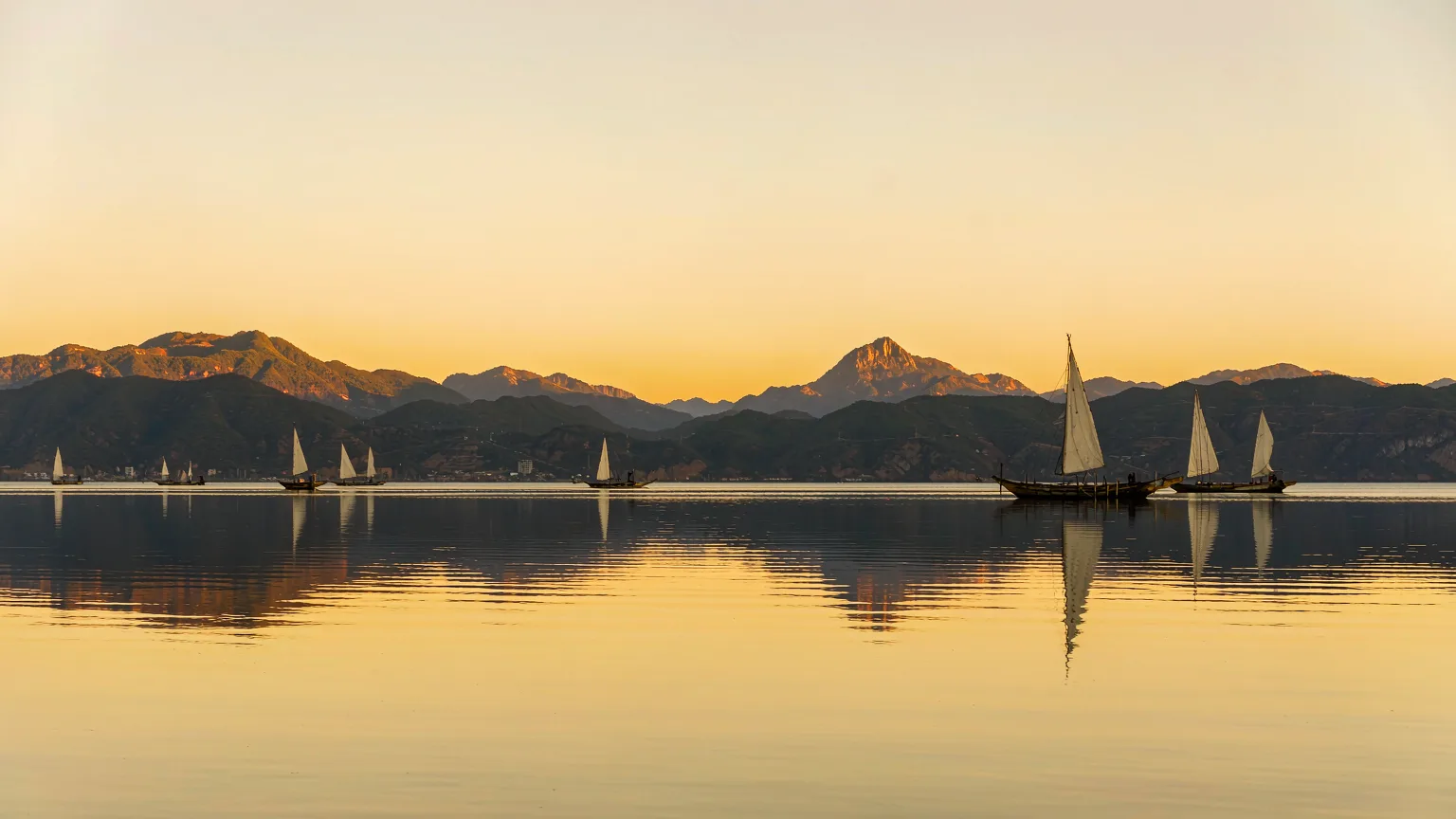
The full lake loop runs well past a hundred kilometers, and three days give Erhai room to breathe: no racing the circle, only watching how water and shore negotiate. The west shore is pastoral Dali, rice fields and villages hugging the lake; the east shore is rocky Dali, hills plunging straight in, the light changing angle all day.
Day one enters the corridor at Caicun and rides north, sleeping in Xizhou or the old town; day two crosses to the east shore and runs south through Shuanglang, Little Putuo and Wase; day three returns to the lake's southern end to close at Erhai Park and Longkan Wharf. Ride or drive half of each day, and give the rest to doing nothing at the water.
Itinerary at a glance
| Day 1 · 08:30 | Caicun Wharf: Where the Loop Begins |
| Day 1 · 10:00 | The Erhai Ecological Corridor: Five Prime Kilometers |
| Day 1 · 14:30 | Xizhou and Haishe: A West-Shore Afternoon |
| Day 2 · 09:00 | Shuanglang: First Sight of the East Shore |
| Day 2 · 12:30 | Little Putuo: A Seal on the Lake's Heart |
| Day 2 · 15:00 | Wase Caixiangyuan: Fishing-Kitchen Supper at Three |
| Day 3 · 09:30 | Ideal Garden: A Slow Lakeside Morning |
| Day 3 · 14:00 | Erhai Park: Where the Lake Resolves into One View |
| Day 3 · 17:30 | Longkan Wharf: The Loop's Sunset Coda |
The route, stop by stop
Caicun Wharf: Where the Loop Begins
Caicun sits two or three kilometers east of the old town; the wharf once housed fishing boats and now anchors the classic loop start. Morning mist sits on the lake and retired boats lean on the landing. Hire here, open the day with a wharf shot of the water, then roll north into the ecological corridor.
Give the village lanes ten minutes too: ink-wash murals on Bai courtyard walls, and the elders' chess table at the village mouth that never adjourns.
The Erhai Ecological Corridor: Five Prime Kilometers
The corridor's Caicun-to-Longkan stretch is the loop's prime: lake one side, fields the other, with the S-bend, the drowned trees and viewing decks in sequence. The greenway bars motor traffic, so riding can slow to nothing. Before ten the light strikes the water at an angle, far better than noon's flat glare.
Two stops at decks suffice; do not spend the day framing shots. Three days around the lake are about moving water, not camera positions.
Xizhou and Haishe: A West-Shore Afternoon
Ride into Xizhou and leave the bike at the town entrance; split the afternoon in two, town and the Yan compound with lunch first, Haishe Park after four. The spit reaches long into the lake, and evening light slanting from the west shapes reeds and dead limbs against the glare, the west shore's alternate sunset position.
The field-path walk back from Haishe is the bonus: rice and wheat color with the seasons, and stubbled fields make the easiest going.
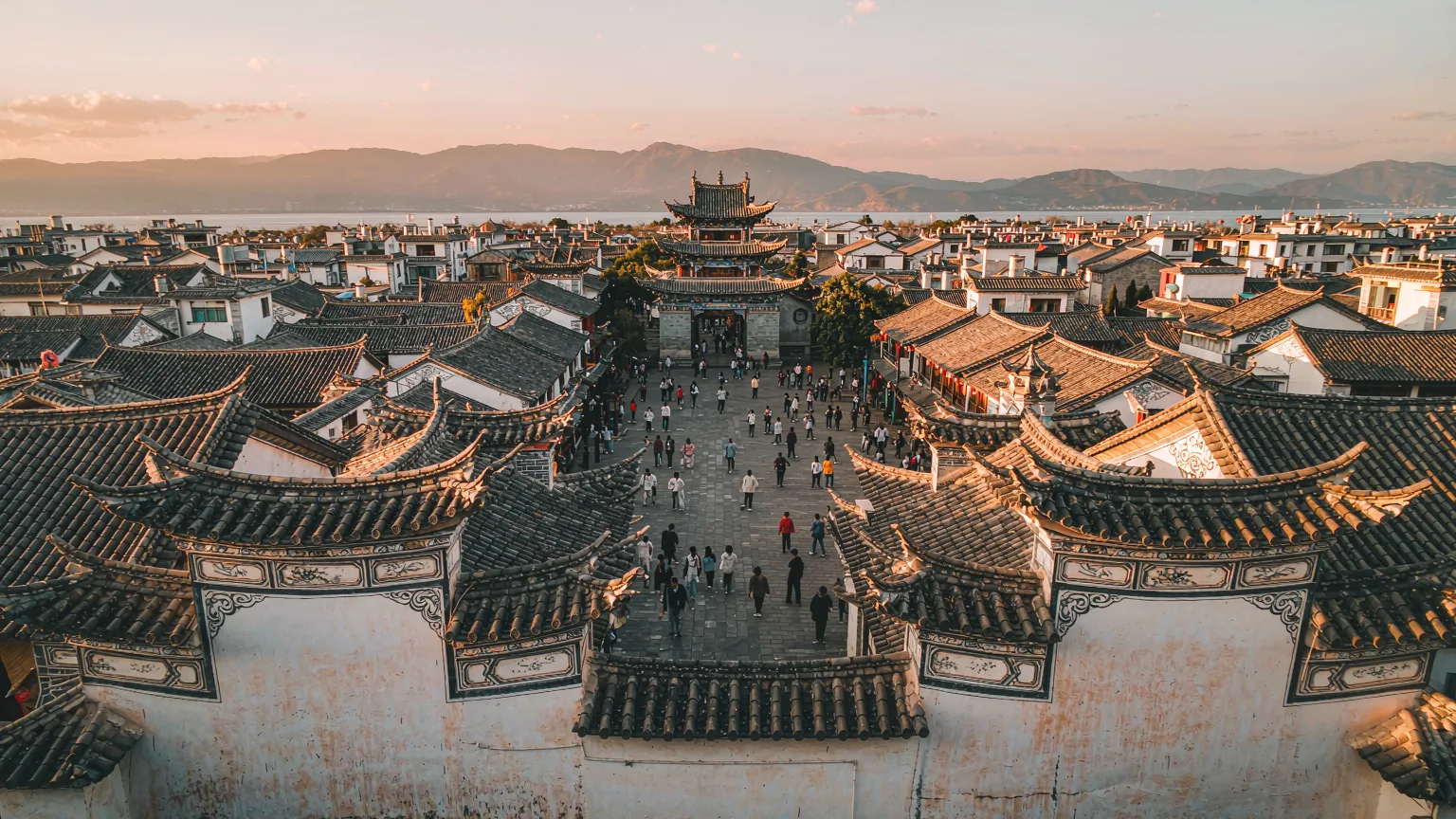
Shuanglang: First Sight of the East Shore
Cross to the east shore early on day two. Shuanglang squeezes between hill and waterline, Yujii Island's lanes barely two shoulders wide. The point here is position, not buildings: looking west from the east shore, Cangshan and the plain become the admired object for the first time, the moment loopers realize how beautiful the west shore was.
Art spaces and lake-view cafes make good rests; the Zhao Qing residence and the Solar Palace area are veteran photo stops, crowded but worth one look.
Little Putuo: A Seal on the Lake's Heart
First stop heading south is Little Putuo, a Guanyin shrine on a reef tens of meters off the bank. Its value is compositional more than touristic: shrine, water and the far foothills of Cangshan compose a standard postcard, livelier still in winter when black-headed gulls gather.
The reef shore steps down to the waterline, fine for long exposures and reflections, but mind the slick footing and rising water.
Wase Caixiangyuan: Fishing-Kitchen Supper at Three
Loop schedules often wreck lunch, and Caixiangyuan in Wase fills the gap: past the meal rush and before dinner, three o'clock seats you calmly. Sour-spicy fish, seaweed-taro soup, fried lake shrimp, a complete sampler of lakeside home cooking. Locals eat here too, and on the east shore its output stays steady.
Digest afterward at Wase Wharf, where reefs and shallows line the bank and four o'clock's light begins to soften; the good photo window starts now.
Ideal Garden: A Slow Lakeside Morning
Day three returns from the east shore to the south, and the morning goes to Ideal Garden, a lakeside space splicing garden, coffee and water view, lawn rolled to the waterline, loungers and parasols scattered among the flowers. Two days of riding legally stall here for a morning.
It belongs at the trip's end, not its start: after two days of scenery you need to sit down and let the lake be background instead of goal.
Erhai Park: Where the Lake Resolves into One View
In the afternoon climb Tuoshan Hill, where Erhai Park's summit folds the three days into one view: west-shore fields, east-shore reefs and the northern bays all laid below. The loop's meaning surfaces here; what you walked was not a list of sights but one lake's different faces.
The park belongs to locals: tai chi elders, kite children, barely any visitors. Half an hour on a summit bench is the loop's best cooldown.
Longkan Wharf: The Loop's Sunset Coda
The last leg returns to Longkan Wharf on the west shore, where a straight jetty pushes into the lake and the Cangshan sunset plays its classic version: the sun sinks off the ridge, the water shifts from gold to gray-blue, and the S-bend you rode on day one enters the frame once more in dusk. Beginning and ending the loop in the same light is this route's perfect symmetry.
With the sunset seen, the lake's three days are complete. The old town and Xiaguan both lie close, and leaving that night or next morning both work.
| Getting around |
|
| Budget | Bike hire RMB 50-100 a day; the loop's road legs by charter or taxi add RMB 600-1000; three days of meals and beds total RMB 900-1800 pp. |
| Best time | September-November bring the clearest skies and bluest water; summer showers push riding to mornings; winter adds gulls as a bonus. |
FAQs
Clockwise or counterclockwise for the three-day loop?
Counterclockwise, west shore first: the west's flat roads make a warmup, and the east shore's punchiest scenery lands on day two while legs and novelty hold; day three's south-shore finish chains transport best. Clockwise hands the hardest east-side riding to day one and the experience suffers.
Can I do this loop without knowing how to ride a bike?
Entirely: walk the corridor or take the site shuttle, and ride vehicles everywhere else. The corridor's prime five kilometers run flat and straight, an hour and a half on foot with closer detail than any saddle. Strike cycling from the list and the line still stands.
What safety notes apply to photography on the lake road?
Three iron rules: never stop for shots on the motor lane, since the lake road runs fast with blind bends and accidents happen yearly; check no-drone signs near villages and wharves; and watch water levels on rocks, for though Erhai is a lake, wind-whipped waves make real drowning risk.
Which stretch deserves the most time in three days?
The west-shore corridor and Haishe: they hold half of Erhai's character, fields, shore, villages and sunset within a few kilometers. Stretch day one to dusk before leaving the west shore, and day two's east side can then run briskly. The rule: give time to the shoreline that changes most, not to checkpoint density.