
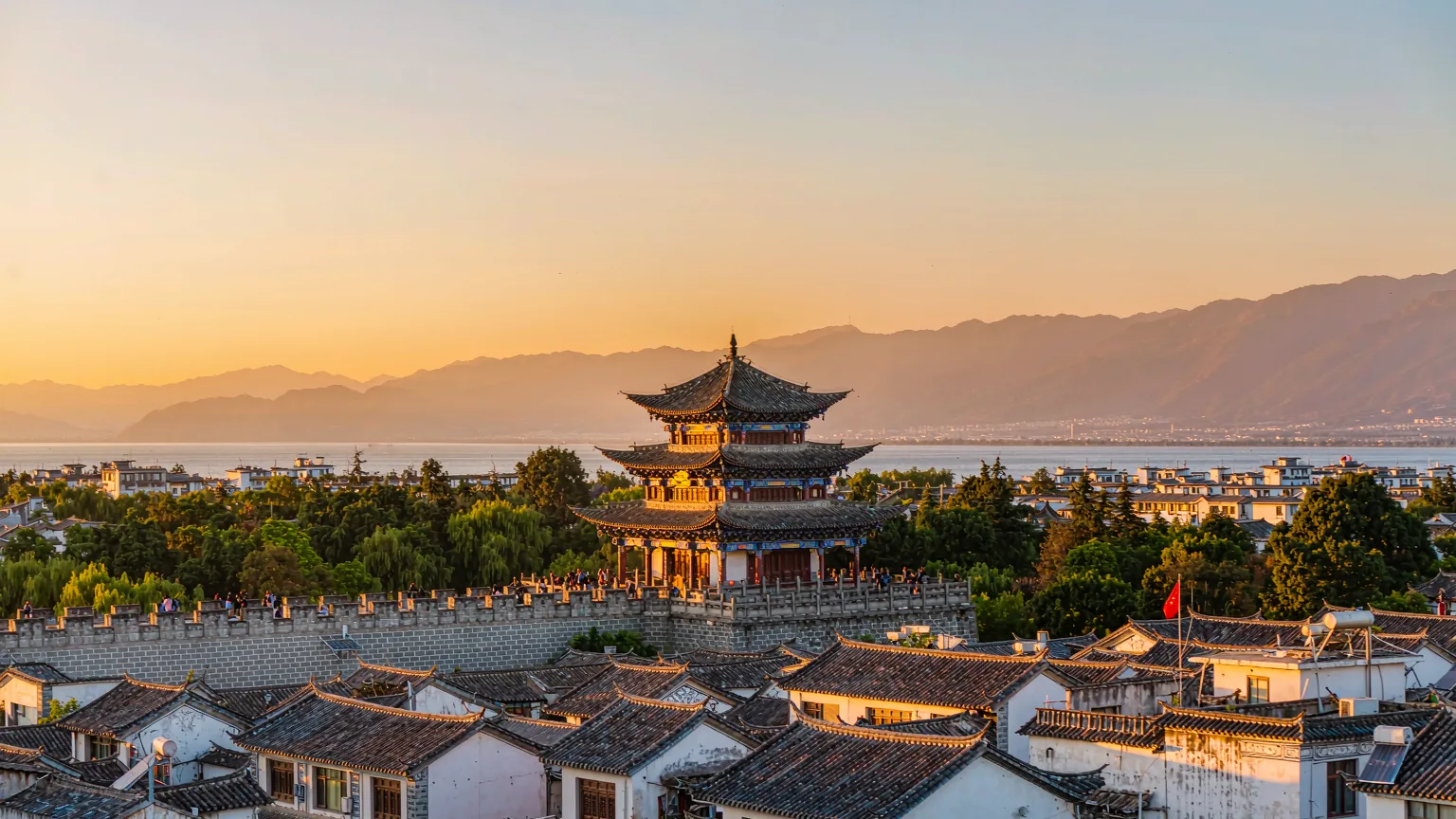
Dali's human depth keeps losing the spotlight to its scenery: this was the capital of both Nanzhao and the Dali kingdom, home to the Bai for a thousand years, with the Tea Horse Road passing its gates. Three days run from the seats of power to folk life: day one, old town and pagodas, the bearing of a royal city; day two, Xizhou and Zhoucheng, how Bai merchants and craftsmen made daily life a discipline.
Day three drives north, stringing Butterfly Spring, Jianchuan woodcarving and Shaxi into one line, ending at the best-preserved market town on the Tea Horse Road. Daily drives stay short and the rhythm stays museum-slow.
Itinerary at a glance
| Day 1 · 08:30 | Dali Ancient City: Fuxing Road and the Marshal's Mansion |
| Day 1 · 11:00 | Three Pagodas of Chongsheng Temple: The Grammar of a Royal Monastery |
| Day 1 · 19:00 | Honglongjing, Dali Old Town: A Bai Tune by Night |
| Day 2 · 08:30 | The Yan Family Compound, Xizhou: A Bai Merchant House |
| Day 2 · 11:00 | Bai Three-Course Tea: A Philosophy Served in Cups |
| Day 2 · 14:30 | Zhoucheng Tie-Dye: Watching a Cloth Come Into Being |
| Day 3 · 08:30 | Butterfly Spring: Where Legend Meets the Water |
| Day 3 · 11:30 | Jianchuan Woodcarving: The Craftsman in Every Chisel Stroke |
| Day 3 · 15:00 | Shaxi Ancient Town: A Living Fossil of the Tea Horse Road |
| Day 3 · 19:30 | Xingjiao Temple and the Square by Night: Evening on the Old Road |
The route, stop by stop
Dali Ancient City: Fuxing Road and the Marshal's Mansion
The heritage line starts with the town's depth, not its shops. On Fuxing Road, the mansion of Du Wenxiu, leader of a Qing-era uprising, now houses the Dali Municipal Museum, holding stelae and Buddhist sculpture from the Nanzhao and Dali kingdoms, the densest physical display of that history and often skipped by visitors, which keeps it quiet.
From the mansion walk Fuxing Road south and read the chessboard lanes and the axis through the Wuhua Tower: the skeleton of Ming-era Dali, a prefectural city whose scale and rank are written into this map.
Three Pagodas of Chongsheng Temple: The Grammar of a Royal Monastery
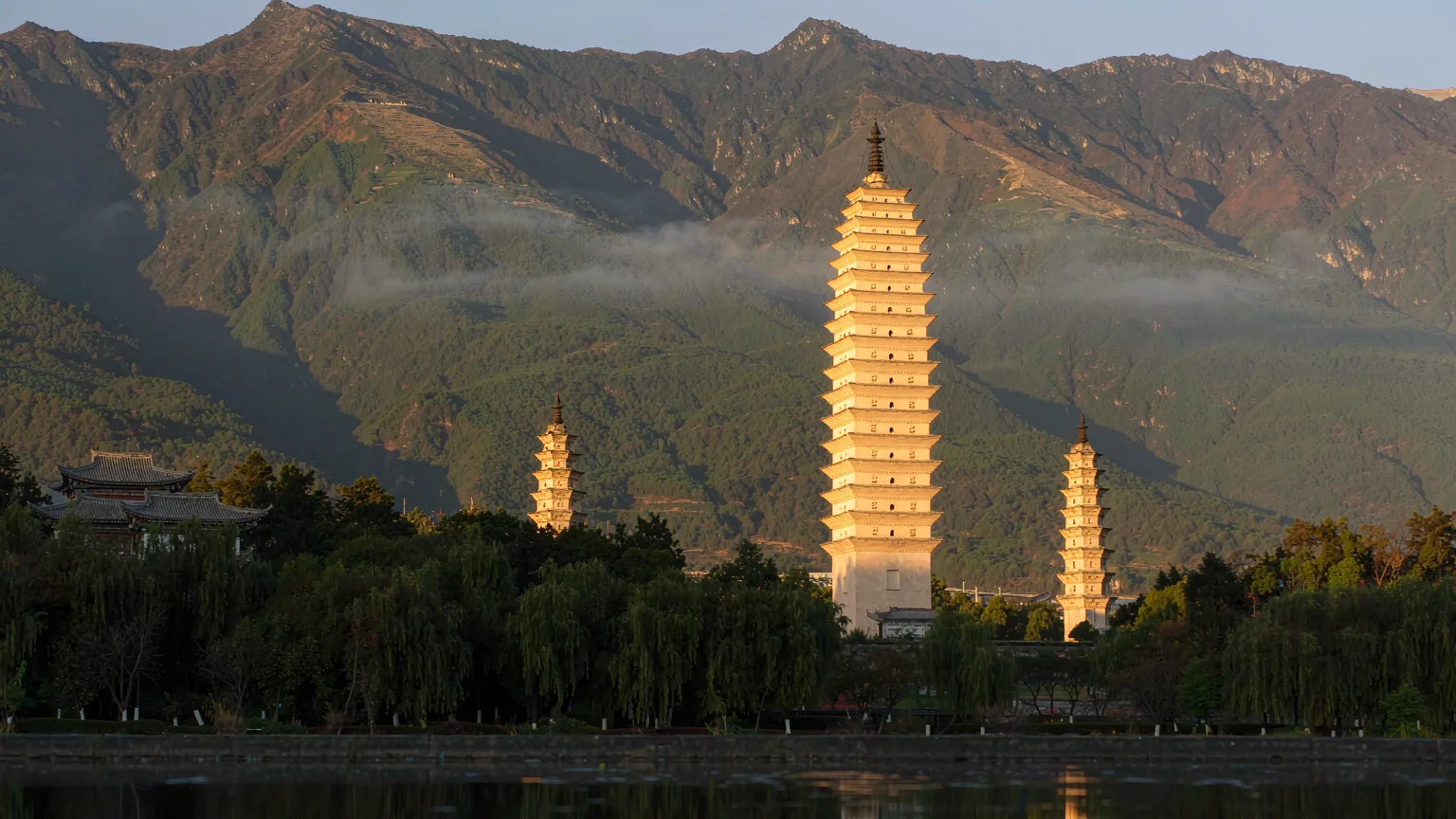
Chongsheng Temple was the royal monastery of Nanzhao and the Dali kingdom, where nine monarchs took vows; the three pagodas are its only surviving ground structures. The Qianxun Pagoda's dense-eave form shares its lineage with Xi'an's Small Wild Goose Pagoda, and the smaller towers' sculpture and cache finds display in the site museum. Read the towers in layers: Tang masonry, a rebuilt temple, and the mountain forever the true subject.
The temple axis points straight into Cangshan; from the great hall, pagodas, halls and peak align on one line, exactly the point of the siting.
Honglongjing, Dali Old Town: A Bai Tune by Night
No expedition on night one; return to Honglongjing. Teahouses along the channel sometimes stage live Bai folk tunes with sanxian lute; sitting in on a set brings you closer to the city's daily grain than any staged show. Half of Dali's heritage sits in its relics, the other half in songs still sung.
The lyrics run in the Bai language, so ignore content and follow melody and mood. A pot of Pu'er from a few tens of yuan covers the evening.
The Yan Family Compound, Xizhou: A Bai Merchant House
Day two reads the Bai through daily life, starting with a merchant house. The Yan Family Compound belonged to Xizhou's richest republican-era family, complete in Bai architectural grammar, three bays facing a screen wall, four quarters around five wells, with a Western-style rear block from the merchants' South Seas trade. The inscriptions on screen walls and the gate carvings all carry meaning, so take a guide.
The compound stages three-course tea and tie-dye displays; if Zhoucheng awaits this afternoon, treat these as a preview and save depth for the source village.
Bai Three-Course Tea: A Philosophy Served in Cups
Noon is the right hour for three-course tea in Xizhou, the town where Bai etiquette survives most intact. The sequence compresses a philosophy: the first cup bitter as the ground floor of any venture, the second sweet as its returns, the third a mingling of every flavor, which is simply experience. The rusun cheese and walnuts beside the tea are all local produce; the refreshments are the terroir.
Beyond the show, watch the host's gestures and the seating order; Bai courtesy lives in daily life, not only on stage.
Zhoucheng Tie-Dye: Watching a Cloth Come Into Being
In the afternoon head north to Zhoucheng, the tie-dye village on the Erhai shore, where the Puzhen workshop at the village mouth preserves the full process: pattern painting, stitching and binding, dipping, unpicking, rinsing, every step of a blue-and-white cloth laid open in the yard. The smell of fermented indigo vats is the village's own air.
A short hands-on session lets you bind and dye your own square scarf, about an hour from stitching to unpicking, the piece yours on the spot. After working it yourself, the shop counter's prices suddenly make sense.
Butterfly Spring: Where Legend Meets the Water
Day three opens north at Butterfly Spring, made famous by the old film Five Golden Flowers. Water seeps from a rock face into a clear pool overhung by a butterfly tree; the great butterfly gatherings of the fourth lunar month were once real, and though the butterflies have thinned, the spring's clarity and the garden's calm remain.
Half the site's interest is landscape, half folklore: the Bai folklore displays and the butterfly specimen hall fill in the legend's background, an hour covers it.
Jianchuan Woodcarving: The Craftsman in Every Chisel Stroke
Push on to Jianchuan, whose woodcarving stands with Heqing silver and Zhoucheng tie-dye as the three Bai craft marvels. In the county town and the carving town workshops, masters cut live, and cloud scrolls, birds and flowers, and full sets of lattice doors show their caliber at half-finish. Jianchuan carvers once fitted most of Yunnan's Ming and Qing temple halls; the flowerwork in old Kunming and Dali buildings came from their hands.
Read it in order: a full lattice door's composition first, then close-up chisel work on faces and feathers, then the finish. For small pieces, workshop-direct stores in town run twenty to thirty percent below old-town shops.
Shaxi Ancient Town: A Living Fossil of the Tea Horse Road
Half an hour southwest of Jianchuan county town lies Shaxi, the sole surviving market town of the Tea Horse Road. Sideng Street's square keeps its full form: stage, Xingjiao Temple, old trees and caravan inns ringing the public space once centered on the horse caravans. At dusk, sitting beside the square as the flagstones' patina glows, Shaxi ranks among Yunnan's most moving towns.
Shaxi keeps a deliberate slowness: no chains, its inns and cafes converted from old houses. Most veterans stay for the lamplit night and return next morning.
Xingjiao Temple and the Square by Night: Evening on the Old Road
Stay for Shaxi's night, opening with Xingjiao Temple, a Ming-era Bai Azhali Buddhist monastery and a rare Esoteric survival in China; the main hall's murals keep legible lines despite the years. The square at night changes temper: the stage lit, visitors gone, locals strolling, the caravan past retiring quietly behind the lamps.
Inns here convert old courtyards, keeping their fire pits and wooden floorboards. Nights run cold, and tea around the fire is the correct Shaxi program.
| Getting around |
|
| Budget | Tickets total about RMB 200-300; three nights of meals, beds and transport run RMB 1000-1800 pp, floating with lodging class. |
| Best time | Year-round; March-April dress the pagodas in cherry blossom and green fields, while winter Shaxi turns quiet with cold mornings. |
FAQs
Do these three heritage days need a guide?
Piecewise guiding beats a full-time guide: the Yan compound, the pagodas and Xingjiao Temple carry dense detail, covered by on-site guides or audio devices, while the old town and Shaxi suit solo wandering. A full-trip guide's fee, spread over three days, wastes most of it on the road.
Is a night in Shaxi worth it, and how should the plan flex?
Yes, Shaxi's essence lives at night and dawn: once day tours drain off, the square returns to villagers' market and strolling ground. Thin out day three, forty minutes at Butterfly Spring and an hour at Jianchuan, reach Shaxi by three, and leave before noon next day.
Which parts reward children most on this line?
Hands-on parts win: Zhoucheng's dyeing session and Jianchuan's live carving demos both suit kids, and learning the tea-offering manners at the ceremony delights them. Cap steles and murals at twenty minutes and swap commentary for stories, like the nine kings who took vows, which children actually keep.
How do rainy season or winter affect this heritage line?
Weather touches this line least, since halls and workshops sit indoors, and rainy days actually suit it. Winter asks two things: Shaxi nights drop below zero, so confirm the inn's fire pit works; and the Jianchuan-Shaxi road can close under ice, so ask your driver about conditions and prefer vehicles carrying chains.