
Huizhou villages are not ten copies of one sight: each village's water gate, halls and lanes answer a different clan and trade. This route follows the merchant roads, day one at Xidi and Hongcun for wealth, day two at Tangmo and Tangyue for ritual, day three in Shexian for office and market.
Ten stops in three days sounds dense but runs loose: drives between villages stay under forty minutes and midday naps at the hotel are realistic. Photographers give dawn and dusk to the villages and noon to the road, the highest yield of light.
Itinerary at a glance
| 09:00 | Xidi: A Boat-Shaped Village and the Hu Clan's Fortune |
| 11:30 | Hongcun: The Ox-Shaped Water System, a Scholarly Answer |
| 15:00 | South Lake Academy and Hongcun at Night: Rooms for Scholars |
| 08:30 | Tachuan: A Color System under the Chinese Tallow Trees |
| 11:00 | Tangmo: A Water Gate That Imported West Lake |
| 14:30 | The Tangyue Archways: A Clan History in Seven Gates |
| 09:00 | Huizhou Old Town and the Xu Guo Archway: A Prefecture's Frontispiece |
| 11:00 | Doushan Street: Deep Houses inside the Prefecture |
| 14:00 | The Yuliang Weir: A Ming Waterwork on the Lianjiang |
| 16:00 | The Yuliang Fish Lantern Hall: A Colorful Full Stop |
The route, stop by stop
Xidi: A Boat-Shaped Village and the Hu Clan's Fortune
Xidi lays out like a boat, the village entrance its bow. The Hu clan settled here from the Song era onward and raised generations of scholar-merchants through the Ming and Qing, leaving two hundred-plus period houses still inhabited. The trick to reading Xidi is looking up at gate towers and down at column bases, since the carved brick gate is every household's face.
Three stops matter most: the Dafu mansion with its embroidery balcony and inscriptions, the Zhuimu hall's merchant exhibits, and the Jing'ai ancestral hall's ritual layout. The lanes run narrow and deep, and nine-o'clock light splits the high walls into bright and shadowed halves, the golden hour for photos.
Hongcun: The Ox-Shaped Water System, a Scholarly Answer
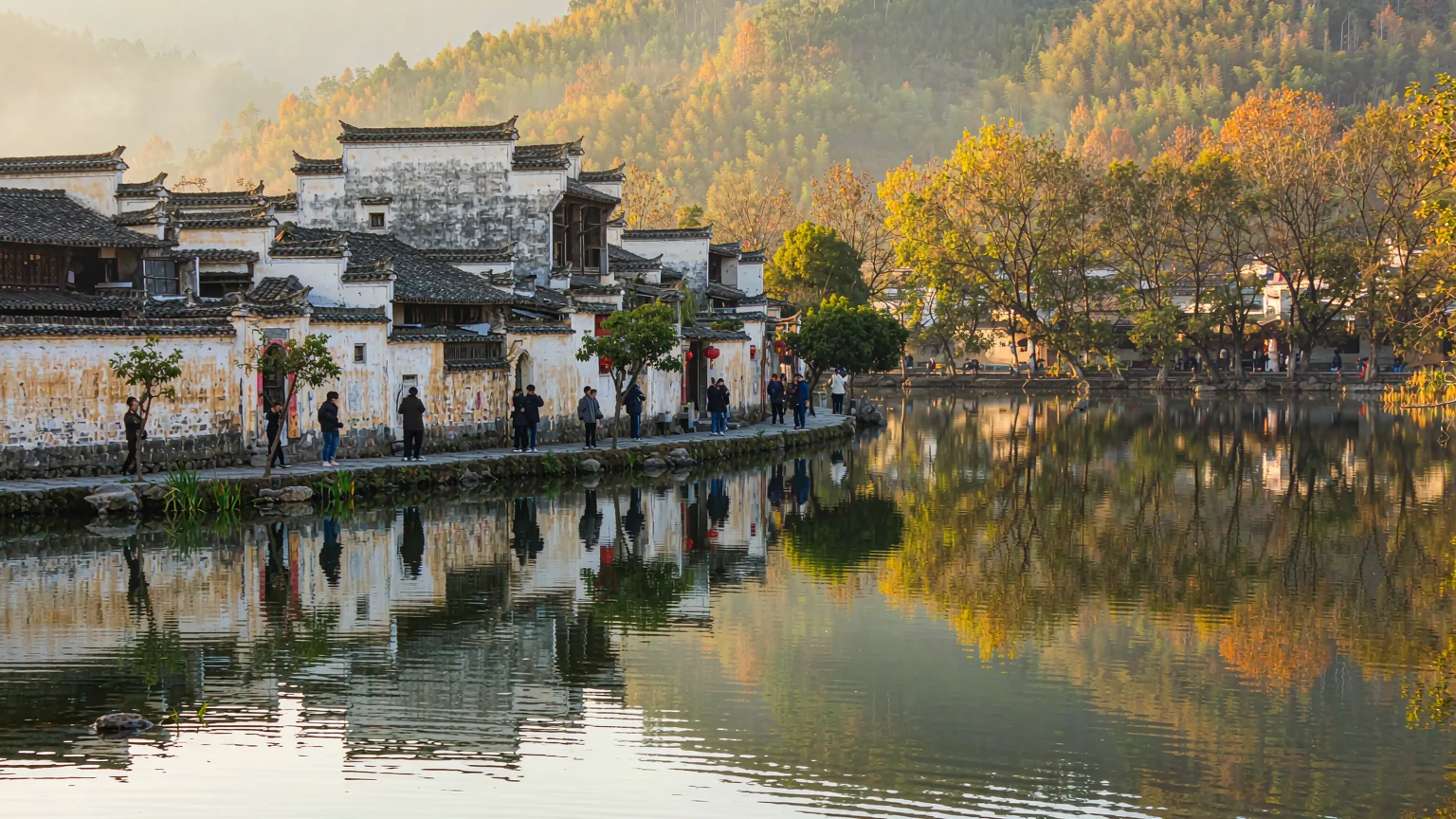
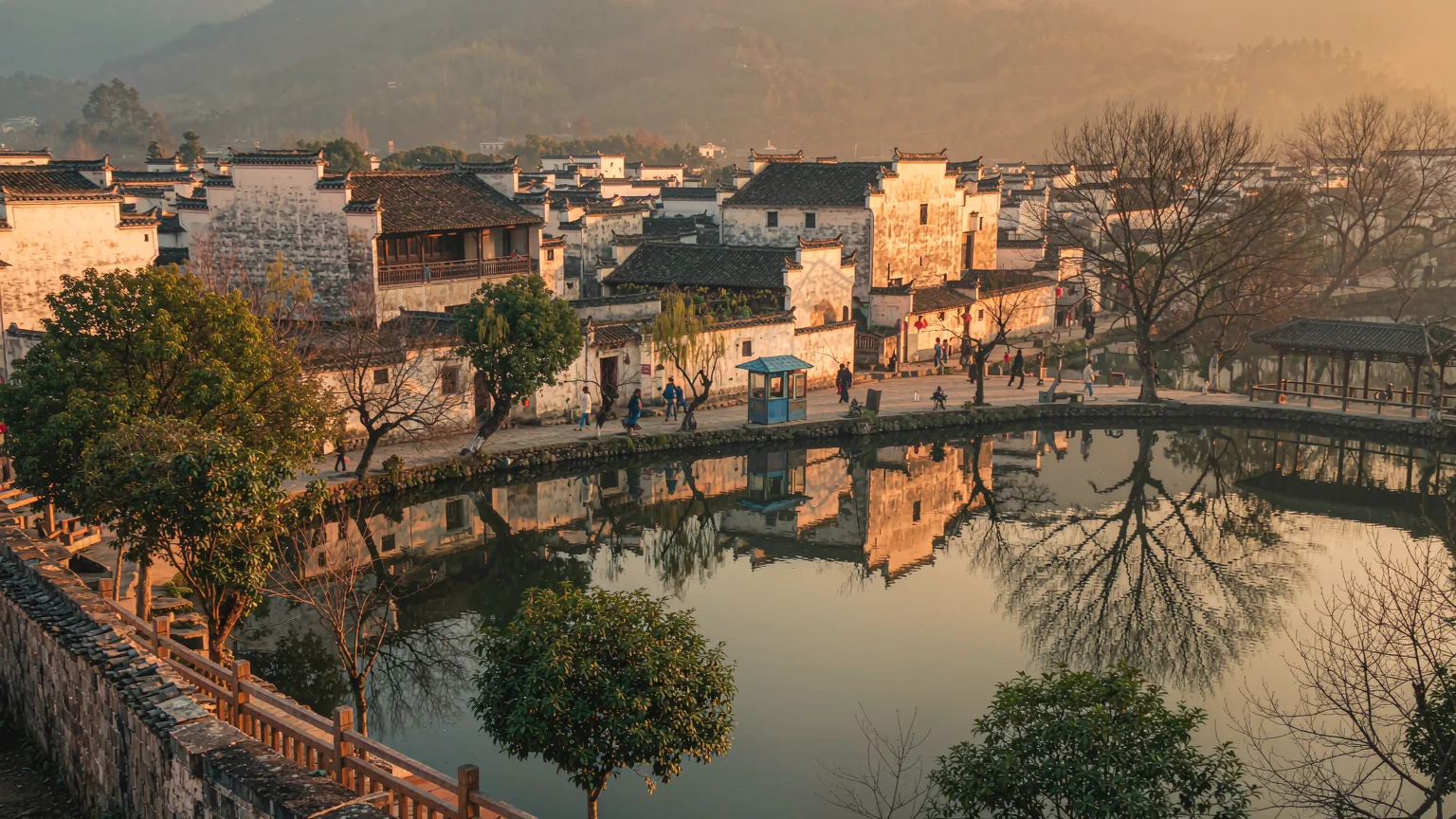
Hongcun is the honor student of Huizhou villages: a Ming-era clan planned an artificial water system that runs the whole village as an ox, Moon Pond the stomach, the channels the gut, South Lake the belly. Living water at every doorstep solved fire, drinking and irrigation in one, a municipal work from six centuries ago.
Lunch in the village at noon, then the afternoon belongs to Chengzhi Hall, a salt merchant's mansion sheathed in gilded carving up the beams, the very footnote to the phrase folk palace. Afterward sit an hour by South Lake and wait for the light to walk onto the painted bridge.
South Lake Academy and Hongcun at Night: Rooms for Scholars
South Lake Academy was the companion project of Hongcun's water plan, where clan sons read the classics and later generations produced notable scholars. The halls and pavilion keep their full layout, and the square of light falling down the light well is the village's finest place to sit and think.
After dark the tour groups withdraw and Hongcun becomes a village again: lanterns along the channels, villagers gathering dried bamboo shoots at the lane ends. One night in an in-village guesthouse repays the detour many times.
Tachuan: A Color System under the Chinese Tallow Trees
Tachuan is famous for autumn: the massed tallow trees at the village entrance turn red, gold and green in late November, against white walls, dark tiles and field ridges, a textbook frame for Chinese photography. Other seasons hold their own, spring rapeseed and summer green paddies with different temperaments.
The best stands sit on field paths and the hillside trail outside the village, no need to enter its core. With morning mist Tachuan fades into a watercolor, and once the light hardens after ten, the window closes.
Tangmo: A Water Gate That Imported West Lake
Tangmo's water-garden gate is a Huizhou marvel: the Xu clan, honoring a mother's wish, built the Tanggan Garden modeled on Hangzhou's West Lake, with a water street unrolling along the Tanggan stream, stone bridges, tea pavilions and old trees in sequence, and villagers still washing clothes at the bank. Its title as the finest water-gate village in China is earned.
Walk the water street end to end and back: Gaoyang Bridge and the two Imperial-Academy archways each carry a story. Compared with the crowds of Xidi and Hongcun, Tangmo's quiet lets you hear the stream, its true luxury.
The Tangyue Archways: A Clan History in Seven Gates
At Tangyue seven archways line the road in sequence, loyalty, filial piety, chastity and righteousness each holding a slot, the Bao clan's four centuries of official commendation in stone. Read beyond the masonry: each gate's imperial year, cited deed and carving motifs assemble into a textbook of ethics.
Pair it with the neighboring Bao family garden and the two halls, the men's Dunben and the rare women's Qingyi. The women's hall is Tangyue's best pause: built for the clan's women at equal standing, a glimpse of the merchant household's other face.
Huizhou Old Town and the Xu Guo Archway: A Prefecture's Frontispiece
Day three enters the Huizhou old town in Shexian, seat of the prefecture. The Xu Guo archway, a rare eight-legged tower raised by Grand Secretary Xu Guo on his homecoming, runs four columns and four faces, its stone carving worth a long look in sunlight; it is also the town's spatial origin, lanes radiating outward.
The Yanghe gate, the drum tower and the prefecture yamen chain together on one line, and the shops on the commercial street offer ink and inkstones at better value than the parks. Give the morning to the prefecture and the afternoon to the river.
Doushan Street: Deep Houses inside the Prefecture
Doushan Street is Shexian's mansion quarter, Ming-Qing official and merchant houses bunched into canyons of wall with a slit of sky. With the Ye family chastity gate and period residences, it stays light on commerce and heavy on daily life, the old town's most lived-in stretch.
Lunch happens in the lanes, where stalls sell hairy tofu and stone pancakes. Walk it quietly: narrow lanes, high thresholds, many households, and lowered voices are basic courtesy to residents.
The Yuliang Weir: A Ming Waterwork on the Lianjiang
First built in the Tang and rebuilt in the Ming, the Yuliang Weir is a granite overflow dam on the Lianjiang, dubbed the Dujiangyan of the south. Its interlocking stone blocks have outlasted centuries of floods, and standing on the crest you grasp at once why Huizhou merchants boarded boats here for Hangzhou.
The fishing-village street bends along the river, drying nets and radish strips overhead. At three or four in the afternoon light lies on the dam as water slides through the joints, the quietest moment of the three days.
The Yuliang Fish Lantern Hall: A Colorful Full Stop
Closing three village days at the fish lantern hall fits perfectly: after houses, halls and archways, finally see how Huizhou celebrates. Fish lanterns carry the local Lantern Festival custom, bamboo frames skinned in paper and painted with scales, the giants danced by several men together.
Book a session to build a small lantern to take home, then walk the old street after dark with it lit, the Lianjiang breeze, the stone slabs and the warm light in your hand, Huizhou's farewell ceremony.
| Getting around |
|
| Budget | Entry tickets dominate, village admissions near RMB 100 each; three days run RMB 600-1000 pp before lodging and meals. |
| Best time | Mar-Apr for rapeseed bloom, mid-Nov onward for Tachuan color; at summer noon the lanes bake, so move into the shaded halls. |
FAQs
If I can only visit one of Xidi or Hongcun, which wins?
Hongcun first: the water system, South Lake and Chengzhi Hall add up to the complete package, with a mature overnight experience; Xidi wins on quiet and house density for detail lovers. The villages sit barely twenty minutes apart, so a three-day plan really fits both, no need to choose.
Can I save on village tickets? How do combos work?
Hongcun and Xidi each near RMB 100 with small online discounts; students and seniors get half or free with documents. Shexian's yamen and the Tangyue archways sell local combos with guide packages. Budget roughly RMB 500 pp for entries across the route, with online platforms a few to a dozen yuan cheaper than windows.
Do ten stops in three days turn into a blur?
Not if you rank them: half a day each for Xidi and Hongcun, two hours each for Tangmo and Tangyue, half a day for Shexian. Each village concentrates its highlights in three to five buildings, the rest is mood and lanes, and alternating intensity is what makes it stick. Keep noon for naps and drives and the legs last all three days.
What should families with kids or seniors watch for?
Three things: stone lanes and thresholds favor folding canes over strollers for seniors and toddlers; halls and houses run dim with uneven steps; and villages bake at summer noon, so start early. A charter beats buses easily, and midday naps back at the hotel are the kindest plan for everyone.