
Three days on Huangshan should not chase spots but master three landscapes: two days on the granite ridge and canyon, the second afternoon on running water, the third on danxia. Ride cableways up and down and spend your legs only on the crest.
One night on the summit is the plan's soul: sunset, sunrise and cloud seas all happen when crowds are thin. Budget travelers survive on hostel bunks while landscape rooms reward deeper pockets; either way, book two weeks ahead at minimum.
Itinerary at a glance
| 08:00 | The Yugu Cableway and Shixin Peak: Opening from the Back |
| 10:00 | Beihai and the Monkey Watching the Sea: Cloud 101 |
| 13:00 | The West Sea Canyon: The Boldest Stroke of the Three Days |
| 17:00 | Sunset at Cloud-Dispelling Pavilion: Why Sleep on the Summit |
| 05:30 | Sunrise on Brightness Summit: The Alarm That Pays the Room Gap |
| 09:00 | Turtle-Fish Peak and the Hundred-Step Ladder: A Slow Movement on the Descent |
| 11:00 | The Greeting Pine and the Yuping Descent: Saying Goodbye |
| 14:30 | Emerald Valley: Giving the Afternoon to Running Water |
| 08:30 | Qiyun Mountain: A Different Mountain on Day Three |
| 14:00 | Yuehua Street and the Hengjiang Fields: A Soft Landing |
The route, stop by stop
The Yugu Cableway and Shixin Peak: Opening from the Back
The smart three-day opening is the back mountain: the Yugu cableway lifts you to Bai'e Ridge in ten minutes, and Shixin Peak comes first. Without Shixin you have not seen Huangshan's pines, and the Black Tiger, Linked Couple and Harp pines cluster here, backlit and translucent in morning light.
The Shixin deck is the first panorama, canyons below and the Stone Bamboo Shoot ridges like a petrified forest. From here the trail rolls gently toward Beihai, saving the climbs for afternoon energy.
Beihai and the Monkey Watching the Sea: Cloud 101
Around Beihai Hotel the trails level out, and the Qingliang terrace is the classic viewpoint. The Monkey Watching the Sea is a crouched rock above the valley; when cloud floods in, the stone monkey genuinely seems to study an ocean.
Terrain here is gentle and views wide, so slow down: find a sheltered rock and spend twenty minutes watching cloud form and dissolve from the valley floor. Odds peak at dusk and dawn, which is the whole reason to sleep up here.
The West Sea Canyon: The Boldest Stroke of the Three Days
Enter the West Sea Canyon from the Cloud-Dispelling Pavilion side: the first loop for the forest of pillars, the second for depth, walkways zigzagging down the cliff face. Today afternoon is your strongest of the trip, exactly where the steepest hour belongs.
From the canyon floor the funicular climbs to the Tianhai station, then walk toward your lodging. The full descent takes three-plus hours, and the car halves the climbing; in winter closure, reroute via the Beihai loop with the structure intact.
Sunset at Cloud-Dispelling Pavilion: Why Sleep on the Summit
Cloud-Dispelling Pavilion faces the West Sea peaks head-on, Huangshan's classic sunset stand. When the sun drops behind the ranks, clouds turn orange, summits become silhouettes, and the crowd goes quiet, a silence that is itself one of the mountain's hidden sights.
After the light dies, walk back to Beihai or the Xihai hotel. Summit rooms are expensive, true, but they buy the privilege of standing at a sunrise point ten minutes after waking, and the ledger balances the moment the cloud sea appears.
Sunrise on Brightness Summit: The Alarm That Pays the Room Gap
Leave at half past five and walk to Brightness Summit in the dark, a handful of silhouettes already on the platform. In the blue hour, mist from Tianhai and Yugu moves between the peaks like tide; the ten seconds of sunrise trigger the whole mountain's shutters at once.
Breakfast near the summit, then declare today the descent: Turtle-Fish Peak, the Hundred-Step Ladder and the Greeting Pine marching you toward the front mountain, reaching the Yuping cableway before noon with margin to spare.
Turtle-Fish Peak and the Hundred-Step Ladder: A Slow Movement on the Descent
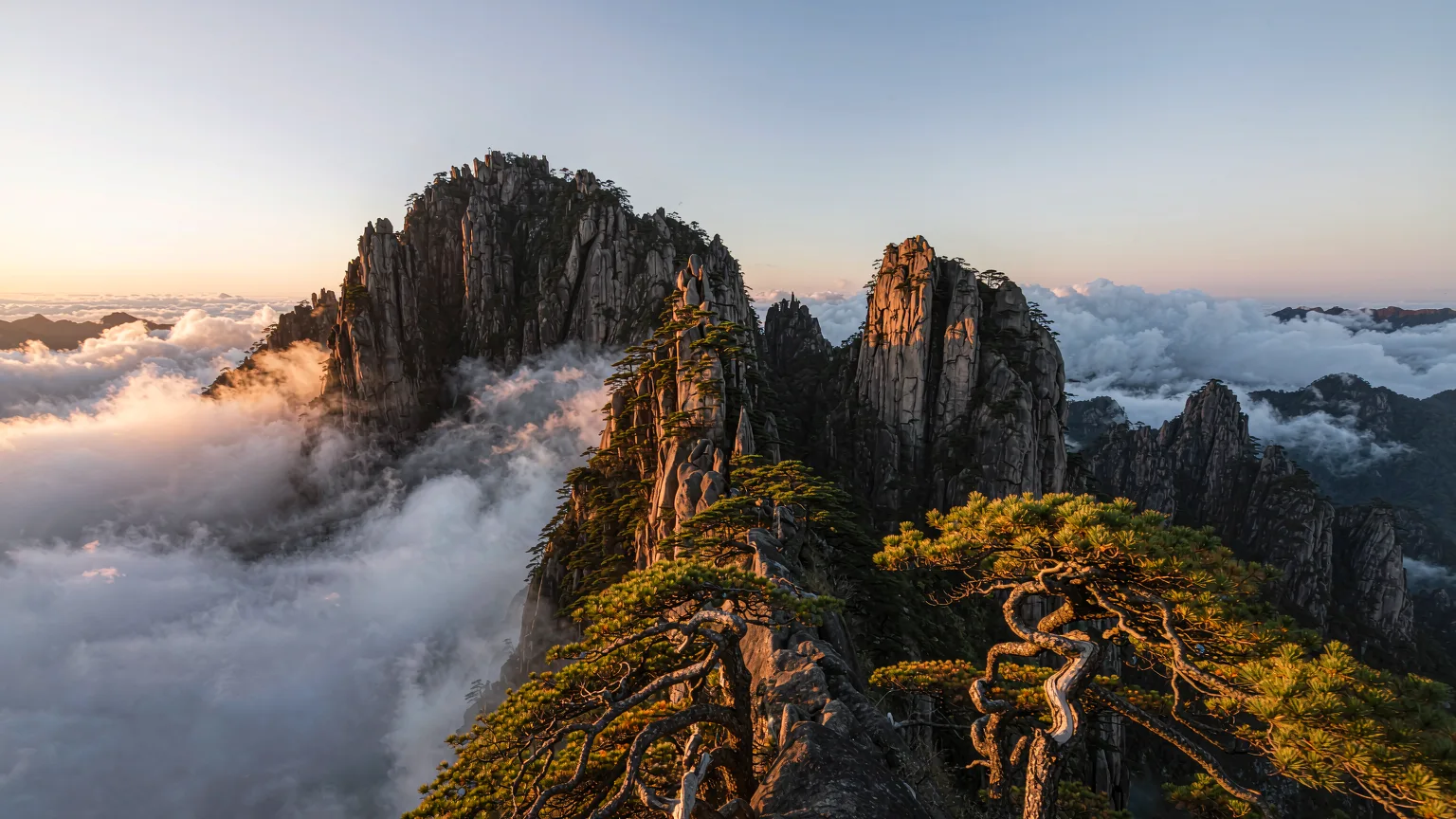
From the Tianhai side, look back at Turtle-Fish Peak and yesterday's route takes a new shape in morning light. The Hundred-Step Ladder is near-vertical steps chiseled into the cliff, descended sideways with one hand on stone, Lotus Peak's wall above and a bottomless cloudy valley below.
Walking this stretch slowly has a bonus: the front mountain is the classic approach to the Greeting Pine, and tour groups flood it mid-morning. Descending against the flow, the earlier you clear it, the calmer it gets.
The Greeting Pine and the Yuping Descent: Saying Goodbye
At eleven the light is kindest to the Greeting Pine, every detail of the Qingliong rock and the crown clear. Unlike the day-trippers' rush, you arrive having seen the canyon and the sunrise, and the tree reads differently: no longer a checklist item but a closing argument.
The Yuping cableway drops you to Ciguang Pavilion in ten minutes, shuttle back to Tangkou. Keep the afternoon light: a hot meal in town, poles stowed, a different landscape waiting tomorrow.
Emerald Valley: Giving the Afternoon to Running Water
East of Tangkou, Emerald Valley is a gorge fed by Huangshan's streams, pool stacked upon pool in deepening green, the deepest called the Color Pools. Crouching Tiger, Hidden Dragon filmed here, and the bamboo-and-water pairing is the film's palette.
The trail hugs the water on a gentle grade, about ninety minutes through the core. After two days of granite, this is the perfect recovery walk: shoes off beside a shallow pool beats any massage.
Qiyun Mountain: A Different Mountain on Day Three
Day three pivots to Qiyun Mountain in Xiuning, one of China's four Taoist sacred ranges. Opposite to Huangshan's drama, Qiyun is danxia country: purple-red sandstone walls, mesas and caves, gentle paths and level views, a walking pace closer to a stroll.
Taoist temples cling to the cliffs, their carvings sharing color with the rock. Crowds are a fraction of Huangshan's, and your knees will thank the choice.
Yuehua Street and the Hengjiang Fields: A Soft Landing
Yuehua Street is a village market at Qiyun's waist where temples and farmhouses share one stone lane, Taoists and villagers side by side. Lunch here on rural cooking, bamboo-shoot pork and stream fish, tastes far better than the scenic-area standard.
Descend along the hillside path in the afternoon as the Hengjiang bends below in one great curve, two-faced between rapeseed gold and rice waves. From here return to Tunxi or head straight for the rail station, three days of granite, water and red rock closed out.
| Getting around |
|
| Budget | Tickets, cableways and two nights (one on summit) run RMB 1000-1600 pp before meals; the summit room is the biggest variable. |
| Best time | Apr-Jun for cloud seas and falling mists, Sep-Nov for crisp air; Qiyun's danxia colors deepen into autumn and winter. |
FAQs
Summit nights look pricey. Can I skip them?
You can, but you surrender sunset, sunrise and the morning cloud sea, the three most valuable sights, and the trip becomes two back-to-back day runs with heavier legs. The compromise is a summit bunk (a few hundred yuan), saving over half versus twin rooms while keeping the cloud-sea odds intact.
How do I buy tickets and cableways for three days economically?
Entry has peak and off-peak tiers and cableways price per ride, with four rides the three-day ceiling (two up, two down). Buy everything on the official platform with real-name registration; students, seniors and children get half or free entry with documents, so pick the concession type at purchase.
Can I drop either Emerald Valley or Qiyun Mountain?
Yes, and the trade follows your legs and taste: tired knees keep Emerald Valley, flat waterside recovery; appetite for a different landscape keeps Qiyun, danxia and Taoism as Huangshan's opposite. Drop both and day three can be Hongcun instead, an equally valid village-and-landscape pairing.
What gear should the three days carry?
Climbing days: windproof jacket, knee braces, headlamp, two liters of water; valley day: quick-dry shoes and spare socks; Qiyun day: travel light. One warm coat covers the trip, since summit-to-noon temperature swings reach fifteen degrees, and a backpack beats a roller case all around.