
Three pilgrimage days unfold one lineage: the three great temples, Puji, Fayu and Huiji, forming the incense skeleton of Putuoshan; the Guanyin Who Refused to Leave and Chaoyin Cave as the faith's origin; Lojia as the legendary ground of Guanyin's practice and attainment; the Duobao Pagoda and Shancai Grotto as survivals from the Song and Yuan onward; and the Guanyin Dharma Realm as the part the present age writes. Reading three days in chronological order covers twelve hundred years of Guanyin devotion on this hill.
Pacing puts the three temples into day one in one push, crosses the water on day two, and sweeps gaps on day three. Coupons cost pennies; the real expense is queueing, so start each day at opening and finish the most important incense before noon.
Itinerary at a glance
| Day 1 · 07:00 | Puji Temple: Dawn at the First Monastery |
| Day 1 · 09:30 | Fayu Temple: beneath the Nine-Dragon Coffer |
| Day 1 · 13:30 | Xiangyun Road and Huiji Temple: Summits the Third Great Temple |
| Day 2 · 07:30 | The South Sea Guanyin and Zizhulin: Back to the Beginning |
| Day 2 · 10:00 | Chaoyin Cave and the Brahma-Sound Cave: Two Voices of the Tide |
| Day 2 · 13:00 | Lojia Island: The Pilgrimage's Higher Step |
| Day 3 · 08:00 | Shancai Grotto: Praying for Fortune and Wisdom |
| Day 3 · 10:30 | The Duobao Pagoda: A Yuan-Dynasty Stone Tower |
| Day 3 · 14:00 | The Guanyin Dharma Realm: The Lineage's Contemporary Page |
The route, stop by stop
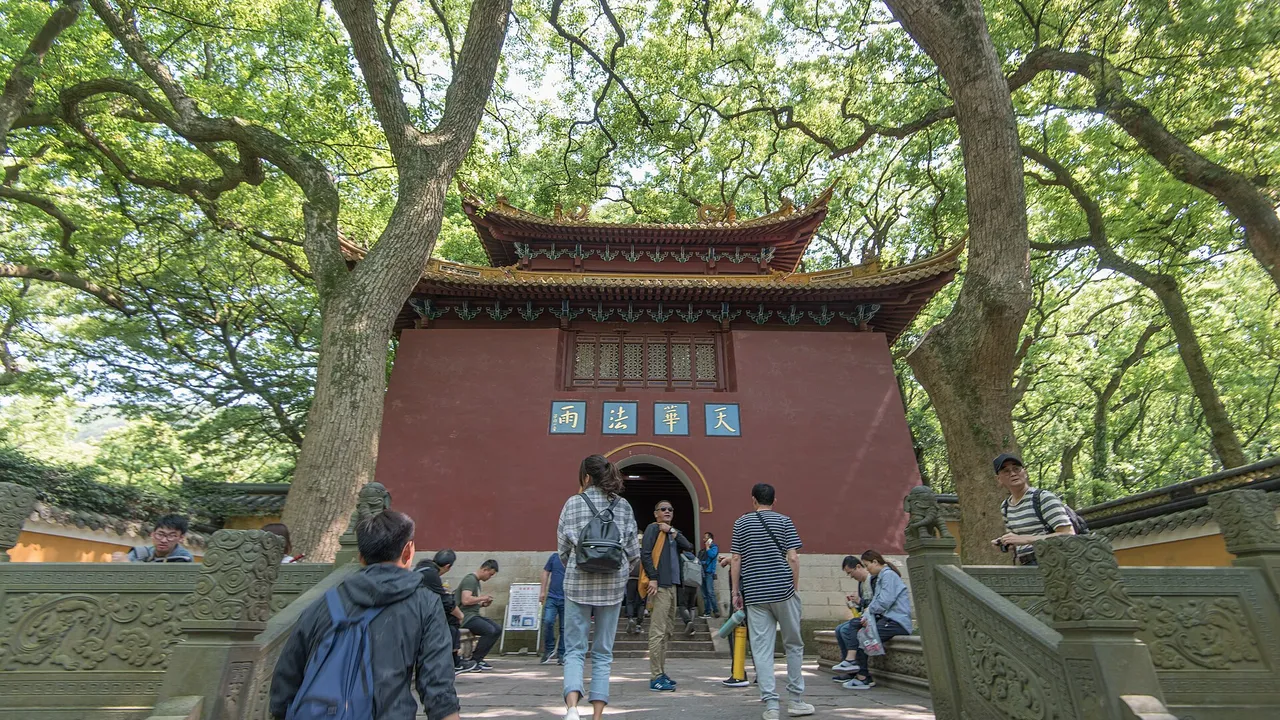
Puji Temple: Dawn at the First Monastery
Enter Puji at its seven o'clock opening on day one. The halls hold almost no one at dawn, candle flames before Guanyin sharing the room with first light, incense spots open for the choosing. The Sea-Print Pond wakes its lotus in morning mist, the stele pavilion's stones still cool from night.
Puji is the home ground of vows: join palms and state your intention before the hall, offer three sticks, speak your wish in silence, circle once. Finishing this routine at dawn lightens the queue pressure for two more days.
Fayu Temple: beneath the Nine-Dragon Coffer
Ride the bus to Fayu mid-morning. Its rank among the three temples stands apart: the nine-dragon coffer was dismantled whole from the Ming palace in Nanjing, eight dragons coiling the walls and one at the crown, whence the Nine-Dragon Hall takes its name. Stand beneath it and imperial craft fuses with Buddhist space.
The temple climbs the hill in six tiers from the Heavenly Kings hall to the Jade Buddha hall. Stone steps behind run to Xiangyun Road, tomorrow's entrance to Foding hill; note the spot today.
Xiangyun Road and Huiji Temple: Summits the Third Great Temple
Take Xiangyun Road from behind Fayu after lunch, a thousand-plus stone steps up Foding hill, forty minutes to an hour. Pilgrims bow every three steps while visitors climb at pace; the sea wind strengthens past midway, and the turn reveals all of Qianbu Sands.
Huiji at the summit closes the three temples, its shaded halls holding the island's highest vantage. Offer the last of the three temples' incense here, ride the Foding cableway down, and the three-temple day completes.
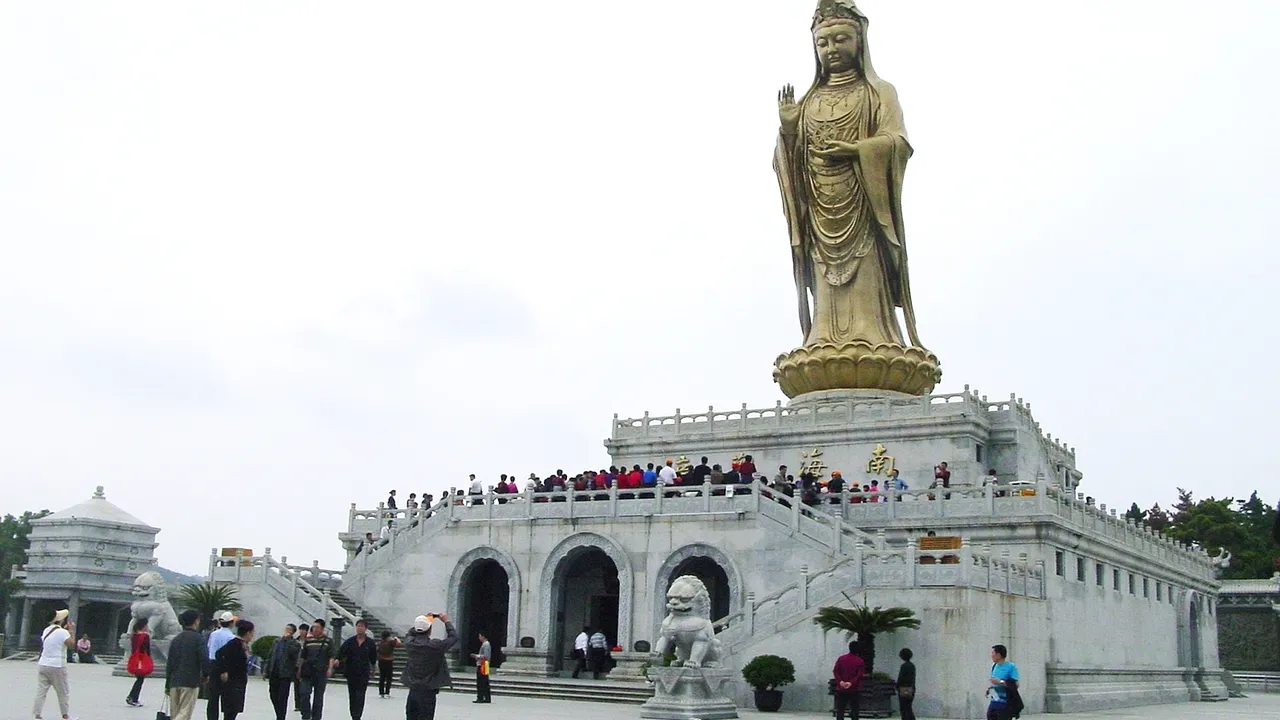
The South Sea Guanyin and Zizhulin: Back to the Beginning
Day two runs in reverse: first the contemporary 33-meter figure, then the origin of faith over a millennium ago. Offer incense before the South Sea Guanyin and circle clockwise; walk on to the Guanyin Who Refused to Leave at Zizhulin, rereading Egaku's tale in morning light.
The coast path between the two points is itself part of the pilgrimage: sea on the left hand, courtyard walls and bamboo on the right. The origins of faith tend to be humbler than expected.
Chaoyin Cave and the Brahma-Sound Cave: Two Voices of the Tide
Take in both soundscapes before noon: Chaoyin Cave beside Zizhulin first, then the Brahma-Sound Cave at the east end. Chaoyin runs deep, Brahma-Sound clear, the ancients naming two voices for Guanyin's two modes of teaching. Match the day's tide table, the sound fullest around the flood.
The bus between them takes twenty minutes; keep twenty-plus minutes of listening at each. Scheduling work for the ears is what sets Putuoshan apart from other sacred mountains.
Lojia Island: The Pilgrimage's Higher Step
Cross to Lojia after lunch. Local saying holds that a Putuoshan pilgrimage is incomplete without Lojia, the reclining-Buddha island honored as where Guanyin practiced to attainment. Temples string along the ridge, worshippers offering their way upward, the far sea beginning just beyond the top lighthouse.
Slow the worship through the three-hour loop, steps many but sea-view platforms at every turn. On the return boat, the reclining silhouette closes day two in a full circle over the water.
Shancai Grotto: Praying for Fortune and Wisdom
Day three opens at the Shancai Grotto on the east shore. The youth Shancai, attendant to Guanyin and seeker of fifty-three teachers, is enshrined within; worshippers here ask for fortune and still more for wisdom. The grotto sits in the cliff, its front platform facing the eastern sea, dawn light spreading the water like one slab of soft jade.
After incense, sit a while on the platform. The heart of Shancai's story is inquiry, consulting fifty-three teachers; pilgrims arriving with questions will find their own reading here.
The Duobao Pagoda: A Yuan-Dynasty Stone Tower
Return to Puji's southeast for the Duobao Pagoda by the Sea-Print Pond. This Yuan-dynasty stone tower is among the oldest surviving structures on the island, its carved Buddhas still sharp after centuries of weather. Tower, pond and temple halls share one frame, among the most photographed corners on the island.
The pagoda's point is its age: in an island full of Qing and Republican building, a Yuan survival only reads fully from a distance. Circle it clockwise and study every face of the carved figures.
The Guanyin Dharma Realm: The Lineage's Contemporary Page
The pilgrimage's last stop crosses to the Guanyin Dharma Realm on Zhujiajian. From the Tang image left on this shore to today's sanctum, the lineage has now been walked whole across three days, and the Dharma Realm proves the lineage still being written. The ninety-plus-meter sanctum holds solemn interior space, its displays tracing the faith's evolution.
After the exhibits, return by ferry or coach. Three pilgrimage days yield not trinkets but one twelve-hundred-year lineage walked end to end, so that every hall on Putuoshan now names the chapter it tells.
| Getting around |
|
| Budget | Island entry RMB 160, great-temple coupons five yuan each, Lojia boat about RMB 70, the Dharma Realm around RMB 90; roughly RMB 600-900 pp over three days. |
| Best time | The Guanyin festivals around the lunar nineteenth of the second, sixth and ninth months run most atmospheric but draw multiples of ordinary crowds; for quiet, choose weekday dawns. |
FAQs
Is festival-season pilgrimage worth it?
Yes, with adjusted expectations: the festival atmosphere around the lunar nineteenth of the second, sixth and ninth months multiplies ordinary days, all-night prostrations and mass chanting unforgettable; the cost is hour-long queues and doubled lodging. Choose festivals for atmosphere, weekdays for quiet practice, both rewards real.
What about coupons and hours at the three temples?
Puji, Fayu and Huiji each charge a five-yuan coupon paid on site; gates generally open between six thirty and seven, last entry near five, with evening offices proceeding inside. Buses link the three within fifteen minutes, so one day walks them with room to spare.
Is Lojia really a must?
In pilgrimage logic, yes: centuries of saying hold the journey incomplete without Lojia, the legendary ground of Guanyin's practice and the lineage's source. But itinerary-wise, weather suspensions and ticket caps are uncontrollable, so with limited strength or only two days, skipping is no shame, the Shancai Grotto and Duobao Pagoda completing the lineage instead.
How to adjust the route for children or seniors?
Ease three points: cableway both ways instead of Xiangyun Road, view Lojia from the pier's reclining silhouette instead of crossing, and swap sun-exposed stretches for the indoor Dharma Realm. The three temples are mostly flat ground, kind to slow family pace. Children's attention runs short, so front-load participatory moments like tide-listening and stupa circling.