
Five days is Putuoshan at ease: no forced choice between worship and nature, both walked in full. Days one and two go deep on the worship spine, day three climbs Foding for the island panorama, day four crosses to Lojia, day five closes on Zhujiajian. Three experiences each keep their own ground, none devouring another.
Every afternoon holds blank space: rest at the inn or idle on a beach when tired. An island runs half a beat slower than the city, and five days exist to let yourself match that rhythm, not to treat the mountain as a checklist.
Itinerary at a glance
| Day 1 · 08:00 | The South Sea Guanyin and Zizhulin: Face and Origin |
| Day 1 · 14:00 | Puji Temple: The First Proper Incense |
| Day 2 · 07:30 | West Heaven: The Panshi Rock and the Ascent |
| Day 2 · 13:30 | Fayu Temple: The Nine-Dragon Coffer and Qianbu Sands |
| Day 3 · 07:30 | Xiangyun Road up Foding: Above the Whole Island |
| Day 3 · 15:00 | The Brahma-Sound Cave: Soundscape after the Summits |
| Day 4 · 09:00 | Lojia Island: Pilgrimage across the Water |
| Day 4 · 16:00 | Baibu Sands at Dusk: Landing after the Crossing |
| Day 5 · 09:30 | The Guanyin Dharma Realm: The Contemporary Close |
| Day 5 · 13:00 | Daqingshan and the Return: One Last Look at the Headland |
The route, stop by stop
The South Sea Guanyin and Zizhulin: Face and Origin
Five days open with face and origin in one morning: incense and a clockwise circle at the 33-meter South Sea Guanyin, then the walk to the Guanyin Who Refused to Leave at Zizhulin to read Egaku's origin tale. A coast path chains the two points, the morning sea wind mild.
The afternoon stays deliberately blank to learn the island: find the bus stops, refectories, pier and sunset points. Day one is for settling in, not collecting sights.
Puji Temple: The First Proper Incense
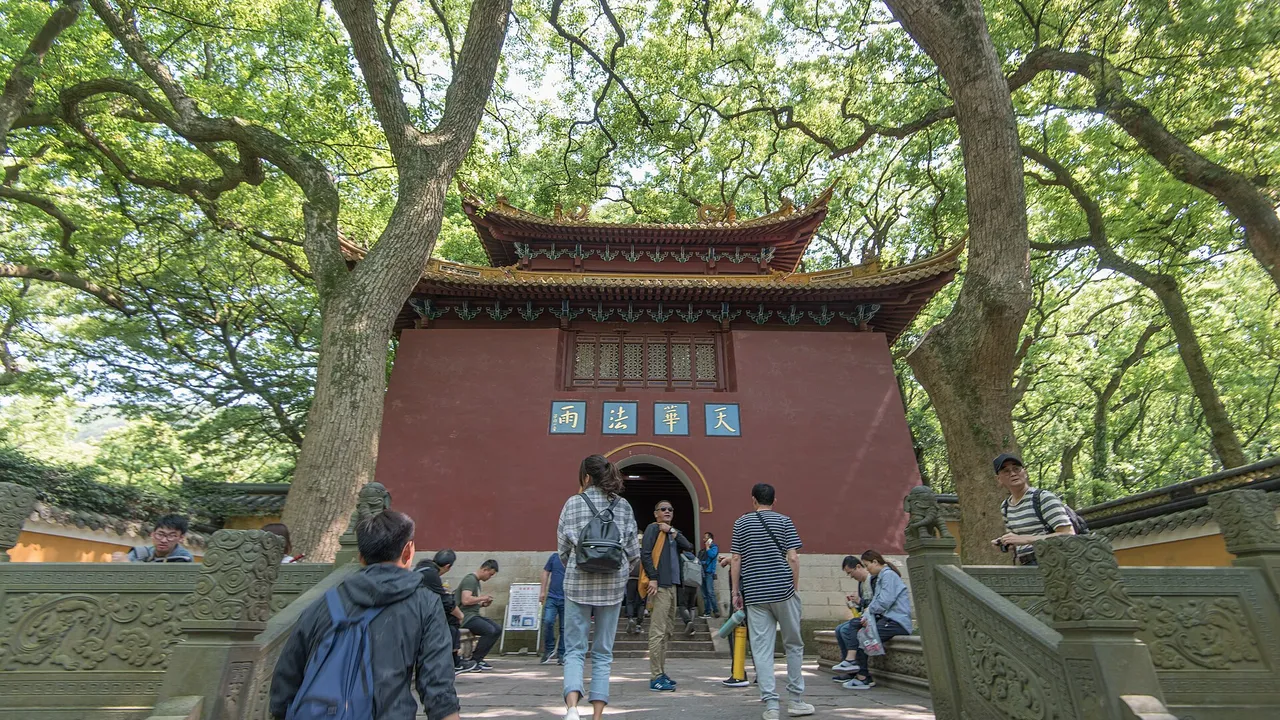
Offer the first proper incense at Puji in the afternoon. The island's principal Guanyin monastery draws an unending stream of vow-makers before the Great Round Compassion Hall. The Sea-Print Pond, stele pavilion and Yongshou Bridge play the overture, the Guanyin figure at its most solemn in afternoon light.
After incense, walk the lane behind the temple to Baibu Sands and hand the incense air to the salt wind. Day one closes near ten thousand steps; after dinner, stroll the main street and watch the island's night rhythm.
West Heaven: The Panshi Rock and the Ascent
Day two climbs through West Heaven. The Panshi Rock, the listening turtles and Meifu Hermitage line the path, its shade and quiet absent from the main pilgrim road. Mid-slope, the southern coast unfolds layer by layer behind you.
The ascent sets no finish line; turn or continue wherever strength says, freedom total. Take temple vegetarian lunch in town and leave the afternoon whole to Fayu and Xiangyun Road.
Fayu Temple: The Nine-Dragon Coffer and Qianbu Sands
Reach Fayu after lunch for the imperial craft of the nine-dragon coffer, climbing from the Heavenly Kings hall to the Jade Buddha hall. Stone steps behind drop to Qianbu Sands, spending one afternoon on both the halls' solemnity and the coast's openness.
By evening Qianbu empties, the sunset bronzing the wet sand. Day two ends on one temple and one beach, the standard five-day template: mountain or temple in the morning, sea in the afternoon.
Xiangyun Road up Foding: Above the Whole Island
Day three climbs Foding in the morning, Xiangyun Road's thousand-plus steps from behind Fayu, forty minutes to an hour to the top. Huiji hides in the summit's tree shade, its platform gathering the whole island, hill, temples and sea, into one gaze, the only high point of the five days.
After summit incense, cableway down and an afternoon nap at the inn. Day three spends its strength in one morning, the descent cable saving knees for Lojia tomorrow.
The Brahma-Sound Cave: Soundscape after the Summits
The afternoon reaches the Brahma-Sound Cave at the island's east end, the auditory high point paired with the morning's visual one. Two cliffs pinch the channel, seawater thundering and revolving, the viewing terrace hanging from the cliff. Match the day's tide table; the twenty minutes around the flood are the peak.
Return to town by dusk with some eighteen thousand steps logged. Sleep early, for day four crosses the water and both sailings and weather deserve slack.
Lojia Island: Pilgrimage across the Water
Day four sails for Lojia in the morning. Looking back, Putuoshan flattens into a rank of blue hills; on the island, temples string along the ridge for an upward line of offering, the reclining-Buddha outline sharpest on clear days. The saying that Putuoshan stays unvisited without Lojia deserves one firsthand test.
Finish the three-hour loop and sail back, resting at the inn after. A crossing day tires more than expected, the boat wind biting, so dress warm and eat well on return.
Baibu Sands at Dusk: Landing after the Crossing
The evening after the crossing holds no agenda, just sunset at Baibu. The sun sinks into the sea and the Lojia direction darkens, the morning's island now a rank of silhouettes. Sit on the sand and replay four days in your head.
An island itinerary finds its rhythm in such closures: ending each day with one fixed act teaches the body the beat, and five days fatigue noticeably less than the same span in a city.
The Guanyin Dharma Realm: The Contemporary Close
The last day crosses to Zhujiajian for the Guanyin Dharma Realm. The ninety-plus-meter sanctum and its immersive displays gather the five days' scattered threads into one complete narrative, the all-weather halls at their best in morning light.
The Dharma Realm exits straight to the Wugongzhi wharf for bags, cars and onward boats or coaches. Placing the contemporary building last closes the five days into a full circle, ancient legend to present hall.
Daqingshan and the Return: One Last Look at the Headland
With time to spare, enter Daqingshan National Park for a ring in the afternoon, the Qingshan deck the best seat for reviewing five days: Putuoshan on the horizon, every coast walked and hill climbed inside the view.
Return from the Wugongzhi wharf before dusk. Five days in, Putuoshan is no longer only a pilgrimage site: it is hill and sea, temple and fishing port, an island shaped together by twelve hundred years of incense and salt wind.
| Getting around |
|
| Budget | Island entry RMB 160, coupons about RMB 25 total, cableway and boats near RMB 150, Zhujiajian sights around RMB 150; roughly RMB 1200-2000 pp over five days. |
| Best time | April-May and September-October optimize all, calm seas and kind walking; July-August brings crowds but is the only window for beach swimming. |
FAQs
Are five days too long?
For visitors treating Putuoshan as a day trip, yes, but five days here do not stretch one day's content; they add Foding, Lojia and Zhujiajian, three pieces no day trip holds. Temples only? Two days suffice. The island's full face? Five fits exactly, four being the compressed floor.
What if weather wrecks the crossings?
Two contingencies: place the Lojia and Zhujiajian crossings mid-itinerary so a cancellation swaps with adjacent days; and keep an on-island fallback, since the three temples' halls, West Heaven and two beaches fill any day. Suspended sailings refund through the original channel, no fare lost.
Stay on the island or at Zhujiajian?
Experience says island: morning and night Putuoshan are different places, and only island guests own an empty Baibu at dawn and the early bells. Budget-conscious travelers can split, two island nights then three at Zhujiajian with half-hour pier commutes, but that adds a ferry daily. First-timers should stay island throughout.
What does the five-day plan cost?
Excluding long-haul transport, budget roughly twelve hundred to two thousand a head: tickets, boats and cableway near three hundred fifty, four nights spanning inn to sea-view rooms, eighty to a hundred fifty a day on food. Season gaps land on lodging, so booking two weeks ahead usually saves a quarter or more, festivals excepted.