
Turpan is the eastern Silk Road's densest heritage basin: Jiaohe and Gaochang anchor west and east, Bezeklik's Uygur-era murals hang in the Flaming Mountains' folds, the karez has run underground for two millennia, and the museum pins the whole timeline. Three days unfold as one western day, one eastern day, one water day, clean logic, en-route light.
The discipline is heat avoidance: in summer, 14:00-17:00 goes indoors or to the hotel while the six hours after sunrise and before sunset carry all outdoor work. A three-day charter bundle wins on price, and drivers know light and opening hours cold, so let them sequence the day. Heritage tickets are cheap; only the noon sun is expensive.
Itinerary at a glance
| Day 1 · 09:30 | Jiaohe Ancient City: A City Carved from Raw Earth |
| Day 1 · 13:00 | The Turpan Museum: The Timeline behind the Ruin |
| Day 1 · 17:30 | Sugong Minaret: The Day's Closing Light |
| Day 2 · 09:30 | The Flaming Mountains: The Ridge and the Thermometer at Dawn |
| Day 2 · 11:00 | The Bezeklik Thousand Buddha Caves: Uygur Murals in the Mountain's Folds |
| Day 2 · 17:00 | Gaochang Ancient City: The Ochre Dead Capital before Sunset |
| Day 3 · 10:00 | Karez Paradise: The Engineering Epic of Underground Water |
| Day 3 · 15:00 | Grape Valley: The Sweet Terminus of the Heritage Line |
| Day 3 · 20:30 | The Turpan Grape Night Market: The Three-Day Farewell |
The route, stop by stop
Jiaohe Ancient City: A City Carved from Raw Earth
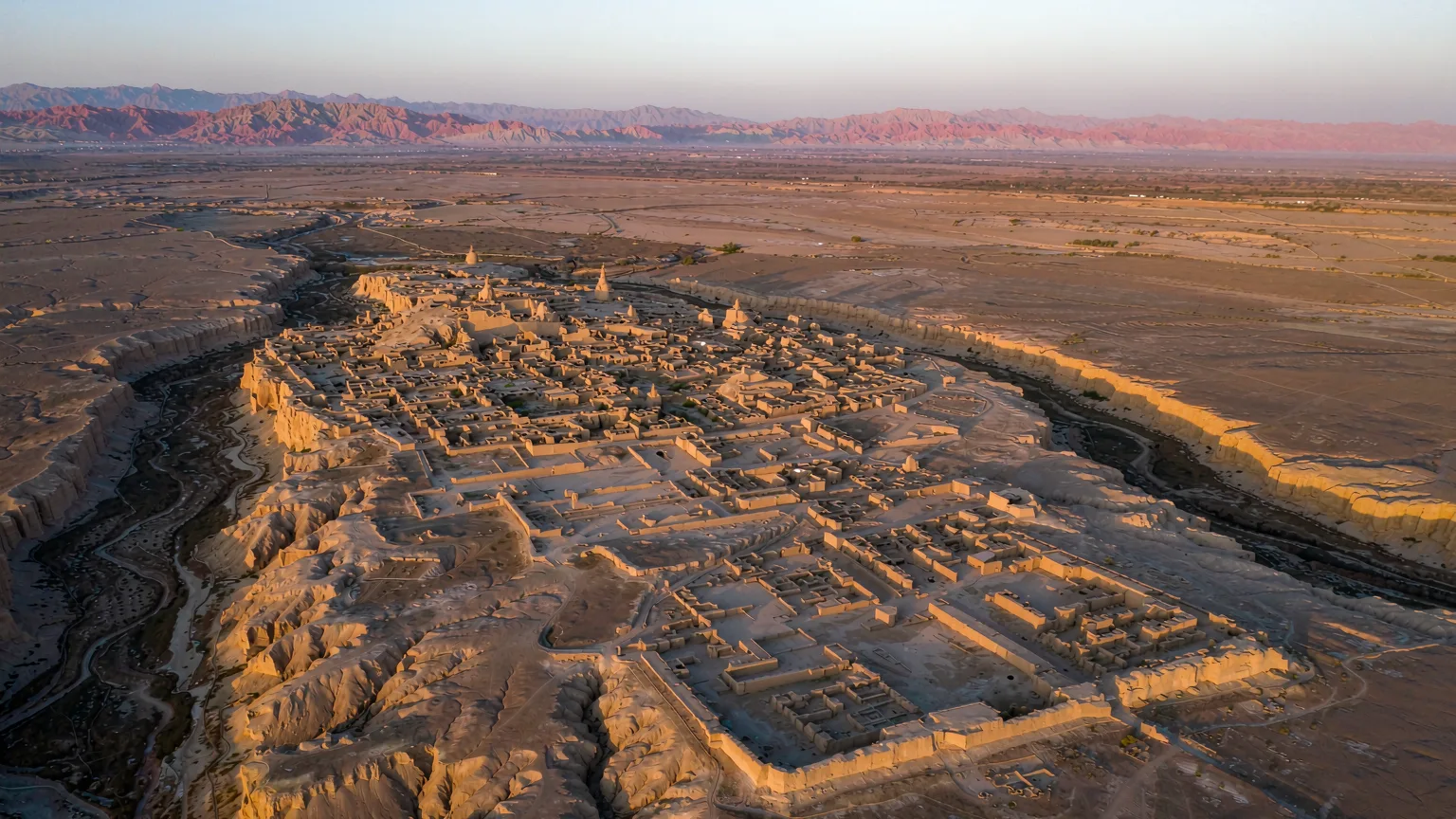
Open the three days with Jiaohe: the whole city dug downward from a willow-leaf plateau, its central avenue, stupa grove, offices and housing still legible after two millennia. Dawn rakes the walls into maximum relief with minimum crowds, and the silence of wind through an empty city beats any museum.
Ninety minutes for the circuit, prioritizing the hundred stupas and the sunken monastery remains. The basin's heritage-grade reading starts here, with the museum supplying its dating footnotes this afternoon.
The Turpan Museum: The Timeline behind the Ruin
Noon hides indoors where the morning's ruin gains dates and context: the giant rhino fossil rolls the basin back twenty million years, the mummy gallery displays aridity as natural embalmer, and Tang-era contracts and letters make Silk Road traders speak again. A national first-class museum, comfortably two hours.
Give the document hall priority: every office and monastery seen at Jiaohe finds its titles and names in the cases. Lunch nearby after, and hand 14:00-17:00, the day's cruelest stretch, to the hotel or an air-conditioned mall.
Sugong Minaret: The Day's Closing Light
Return downtown at dusk for the minaret: a Qianlong-era Islamic tower whose ochre bricks weave fifteen geometric patterns, most dimensional in raking light, with the adjacent mosque hall's raw-earth and timber hush equally worth the visit. Dress conservatively, keep voices low.
The stop closes day one's timeline from prehistory (the rhino) to the Qing (the tower). Dinner downtown and an early night, since day two's mountains and twin sites want a dawn start.
The Flaming Mountains: The Ridge and the Thermometer at Dawn
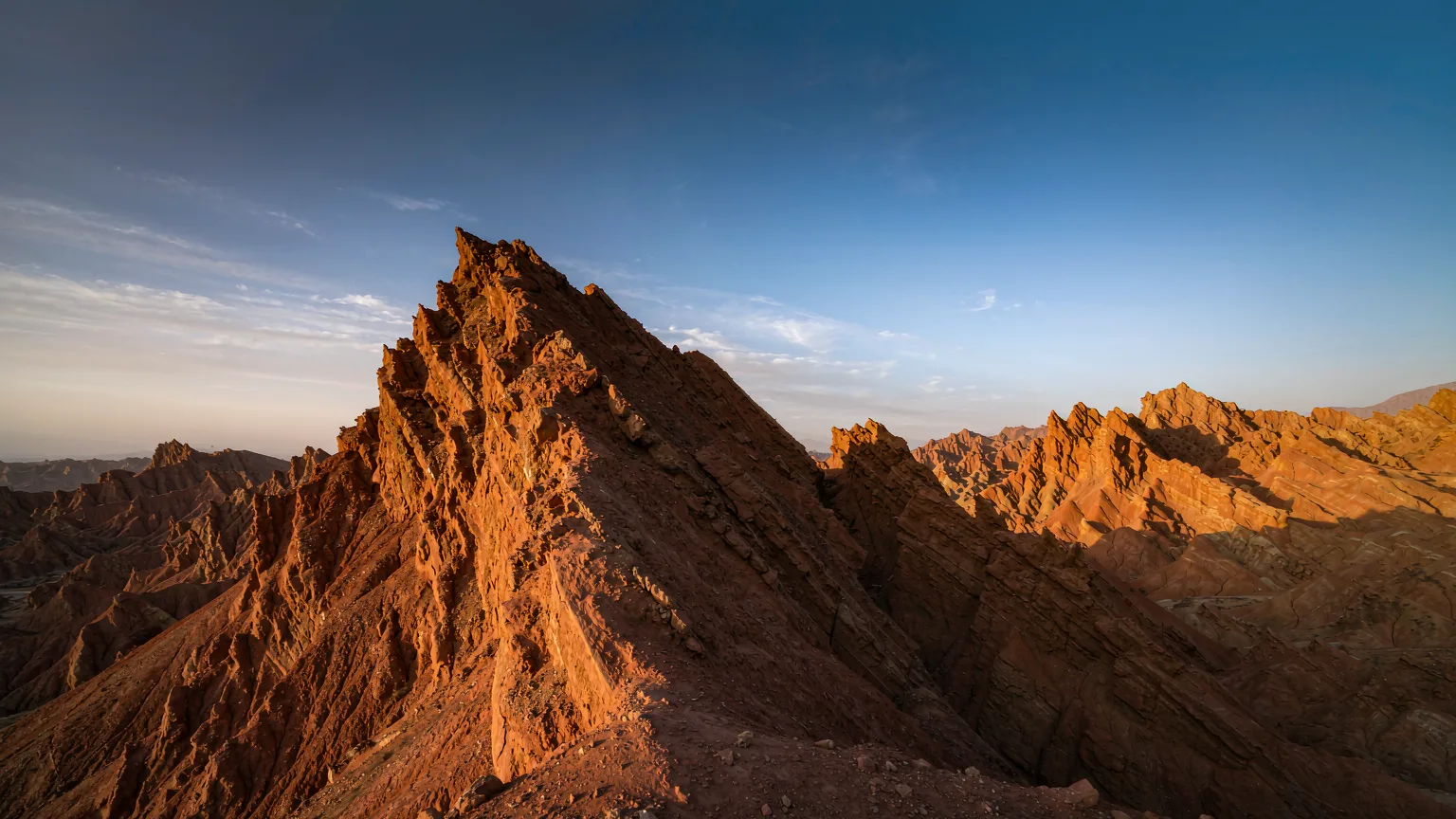
Day two's eastern line opens at the mountains before the heat builds: the ridge reads dark red at dawn, folds crisp, the giant staff-shaped thermometer still low. By day these hills are Turpan's least habitable place, ground past seventy degrees, leaving dawn and sunset as the only visitable windows.
Forty minutes suffice: the sculpture photo, the thermometer reading, one look at the rock texture. The real heavyweight waits in the gullies behind, at Bezeklik.
The Bezeklik Thousand Buddha Caves: Uygur Murals in the Mountain's Folds
Bezeklik cuts into the cliff of the Mutou Valley below the Flaming Mountains, flourishing under the Uygur kingdom of Qocho, its murals blending central-plains, western-regions and Uygur styles, donor figures and sutra-tableau colors still legible. Early twentieth-century expeditions cut away swathes to museums abroad, and the sigh before those blank walls is part of the visit.
Caves rotate for conservation; the open dozen reward an honest hour. Photography is barred inside, so give your eyes to the walls and let the guide's live narration beat any catalog.
Gaochang Ancient City: The Ochre Dead Capital before Sunset
Gaochang contrasts Jiaohe in temperament: where Jiaohe was carved, Gaochang is a vast rammed-earth enclosure, the city where Xuanzang lectured on his westward journey. The walls stretch beyond sight; walking the whole perimeter is unreal, so ride the reserve shuttle to the core and proceed on foot, the ochre ramparts honey-colored in slant light.
The khan's fortress and the Great Buddha Temple remains anchor the visit, about two hours, with dinner back downtown or at a nearby farmhouse after.
Karez Paradise: The Engineering Epic of Underground Water
Day three turns to water. Ranked with the Great Wall and the Grand Canal among ancient China's three great engineering works, the karez feeds the basin through two thousand-plus covered channels; the site shows shafts, tunnels, open channels and reservoirs entire, and stepping into a tunnel drops the temperature from the forties to just over twenty, the water's chill coming straight off the snowline.
The signage explains digging and water-sharing thoroughly, an honest hour with time left to bake your own naan where sessions run. Through the noon stretch this is the day's most comfortable address.
Grape Valley: The Sweet Terminus of the Heritage Line
The third day ends sweet: vines irrigated by karez water weave a trellis canopy overhead, and the Uygur courtyards pour tea, serve pilaf and show raisin strings hanging in the drying houses. Taste seedless whites before weighing, farm prices undercutting town.
Under the trellis, run the three-day ledger once: two ancient cities, one grotto site, one underground waterway, one minaret, plus the raisins in your hand, and the oasis civilization assembles whole.
The Turpan Grape Night Market: The Three-Day Farewell
The farewell dinner sits under the night market's trellises: skewers, grilled eggs, spicy trotters and iced yogurt with seasonal melon, turning three days of civilization sites into a grounded, satisfied stomach.
Afterward, the final luggage audit: sealed fruit, packed boxes, receipts in order. Turpan's heritage is not going anywhere; what flees is the noon sun, so come back in the same season.
| Getting around |
|
| Budget | Entries total about RMB 350-450 (Jiaohe near RMB 70, Gaochang RMB 40-70 plus shuttle, Bezeklik about RMB 40, karez RMB 40, Grape Valley RMB 60-75), with a three-day charter around RMB 300-500 per day. |
| Best time | April-June and September-October are comfortable; July-August works only with each day split into morning and evening halves, noon given to museums and tunnels; some Bezeklik caves rotate open. |
FAQs
Do Jiaohe and Gaochang resemble each other, and are both necessary?
The temperaments differ completely and both deserve it: Jiaohe is a plateau city carved downward, precise and compact like a stranded ship; Gaochang is a vast rammed-earth capital, bleak and grand, bound to Xuanzang's lectures. Seeing the second deepens the first rather than repeating it. Short on legs, protect Jiaohe, but with the route passing Gaochang anyway there is no reason to skip it.
Is Bezeklik worth the trip, and how much mural survives?
Yes, it is Turpan's only full-scale grotto site: the surviving Uygur-era murals still startle with color and composition, and the donors' costume details stand as living reference for Central Asian dress. It is true that expeditions cut away great swaths a century ago, but seeing what remains is precisely the point, the blank wall beside the surviving fragment honest beyond any replica.
How do the three days handle the midday heat?
One rule only: be nowhere unshaded outdoors from 14:00-17:00. Day one spends noon in the museum, day two at a downtown lunch plus hotel rest, day three inside the karez tunnels. Outdoor work concentrates in 9:30-13:00 and after 17:00, with water and electrolytes by the hour and the hat never leaving. Held to this, even July and August stay comfortable.
Does this route suit photographers, and where are the key frames?
Very much so, Turpan is a light-driven location. Five essential frames: dawn's long shadows down Jiaohe's central avenue, the plateau panorama at sunset, the Bezeklik cliff exterior (interiors banned), slant-light texture on Gaochang's ramparts, and the mountains' red faces before sunset. One wide plus one fast lens suffices, pack lens cloths against dust, and drones mostly banned, so check each site's rules.