
Turpan is China's landform textbook: the basin holding the country's zero-elevation point, red ranges whose ground passes seventy degrees, a desert close enough to a city for sandboarding, and a two-thousand-year canal underground. Three days thread them all with hot-cold alternation built in, heat landscapes at the day's edges, cool projects at noon, so the strain barely registers.
The Shanshan direction runs about a hundred kilometers each way, chartering is the low-drama choice, with rail to Shanshan North as the alternative. The heat discipline holds: nobody stands unshaded outdoors 14:00-17:00. The route's hidden protagonist is water, without the karez and Tianshan snowmelt none of these wonders would have a human version, and day three delivers that payoff.
Itinerary at a glance
| Day 1 · 09:30 | The Flaming Mountains: The Dawn Window on a Seventy-Degree Ridge |
| Day 1 · 11:00 | The Desert Earth Art Museum: Wilderness Art Shaped from Raw Earth |
| Day 1 · 16:00 | The Bezeklik Thousand Buddha Caves: A Grotto Complex in the Cliff |
| Day 1 · 19:30 | Grape Valley: Evening under the Trellises |
| Day 2 · 09:30 | The Kumtag Desert: A Sand Sea at the City's Edge |
| Day 2 · 13:30 | The Shanshan New Town Night Market: Lunch and Siesta off the Sand |
| Day 3 · 10:00 | Karez Paradise: The Underground-Water Answer |
| Day 3 · 19:30 | Jiaohe at Sunset: Landform and Civilization Take a Joint Bow |
| Day 3 · 21:30 | Putao Li Old Teahouse: Cooling the Three Days Down |
The route, stop by stop
The Flaming Mountains: The Dawn Window on a Seventy-Degree Ridge
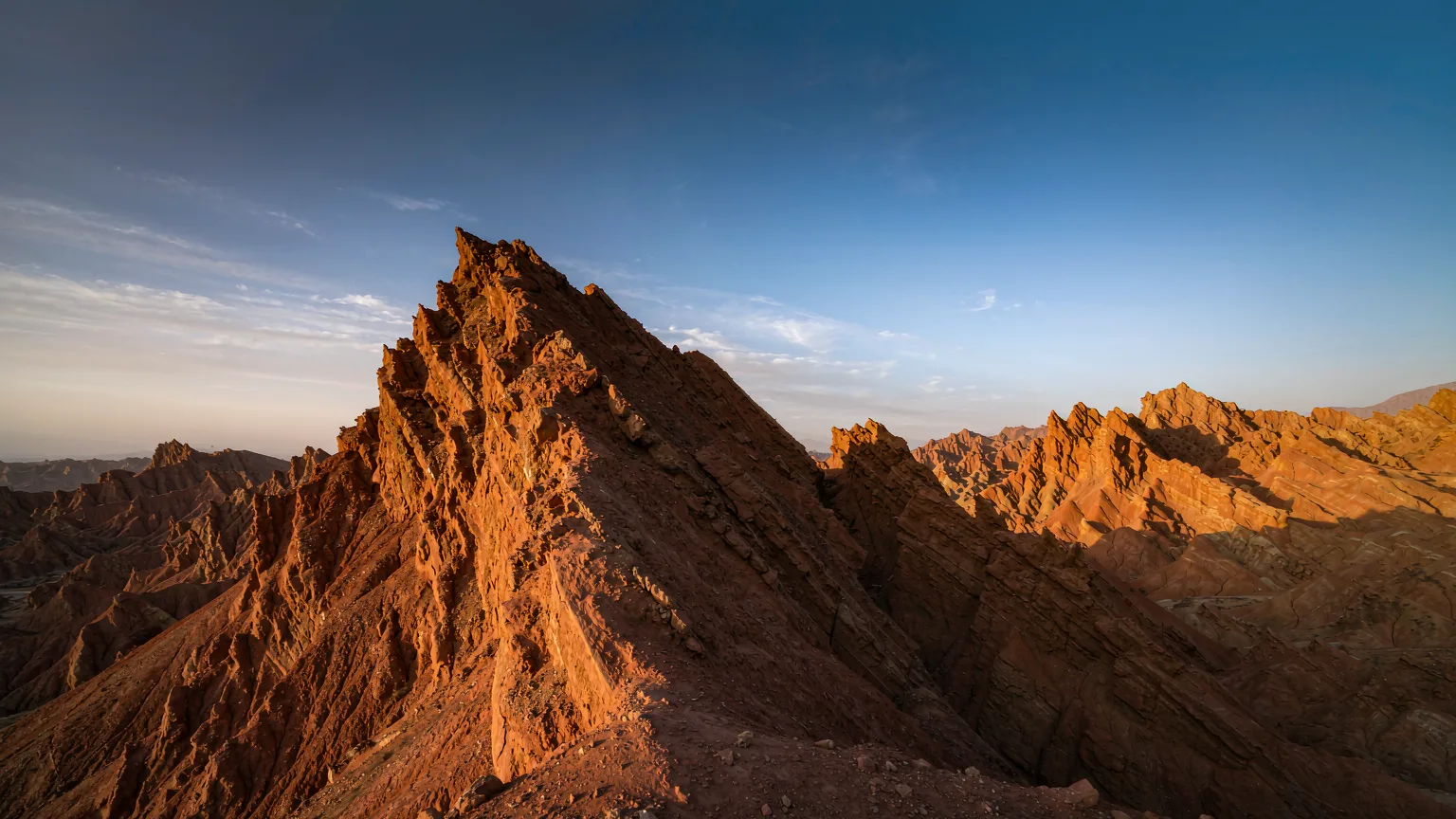
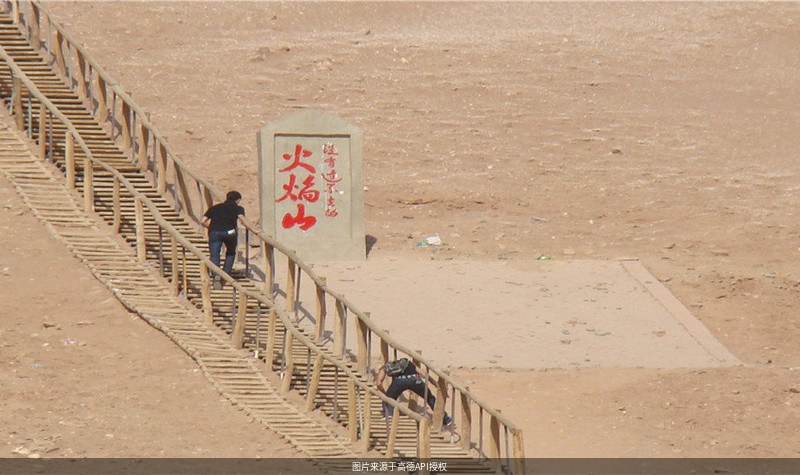
The three nature days open at the hottest landmark, before the heat builds: dawn keeps the red sandstone folds crisp and dimensional, the giant staff-shaped thermometer still near its floor, heat shimmer yet to rise off the ridge-to-gravel line. The red comes from oxidized sandstone and mudstone, geology as the conspiracy of uplift and wind.
Forty minutes suffice, the thermometer, the ridge frames, the Journey-to-the-West sculpture, then leave by ten as ground heat climbs fast, handing the rest of the morning to the gullies below.
The Desert Earth Art Museum: Wilderness Art Shaped from Raw Earth
At the mountains' foot, this earth-art park sculpts raw soil into buildings and figure groups, kneading desert, Silk Road and folk tales into ochre scenes in a strange same-palette dialogue with the red ridge behind. Its point lives in the phrase locally sourced, material, color and terrain all one, as if grown from the ground.
The park runs small, an unhurried hour, outdoor pieces photographing well while indoor halls offer shade. By eleven the light whitens, so save detail shots for a return pass at dusk.
The Bezeklik Thousand Buddha Caves: A Grotto Complex in the Cliff
At four, enter the Mutou Valley where grottoes stack along the cliff, flourishing under the Uygur kingdom of Qocho with murals blending central-plains, western-regions and Uygun styles. The gully runs several degrees cooler than the plateau, afternoon light slanting from the mouth to model the cliff, while the caves hold their year-round cool.
Open caves rotate, an honest hour covering them; photography is barred inside, so give your eyes to the walls, the donors' costumes and sutra-tableau compositions, multiple cultures overwriting one wall.
Grape Valley: Evening under the Trellises
Day one closes in Grape Valley, the oasis gorge beneath the mountains where trellises shade the whole lane and Uygur courtyards mix tea and fruit scents. Evening drops the temperature; sit under the vines with a bowl of tea and watch drying-house silhouettes against the darkening sky.
Taste seedless whites and rose-scents before weighing, though farm-direct buying can wait a day for comparison; tonight's job is a farmhouse dinner under the canopy, digesting the day's red and cliff.
The Kumtag Desert: A Sand Sea at the City's Edge
Day two's heavyweight sits in Shanshan: the Kumtag Desert is famous as a city-adjacent sand sea, its dunes starting almost at the county streets, oasis roads on one side and unbroken sand mountains on the other. At dawn the ridgelines cut sharpest, wind-textured sand fine as fabric, and barefoot temperature is exactly right.
Sandboarding and desert buggies price separately, but photography is the real course here: in the first hour after sunrise the dunes' light-shadow boundary stands crispest. Pack camera dust protection and change lenses inside the car only.
The Shanshan New Town Night Market: Lunch and Siesta off the Sand
Down from the dunes past noon, Shanshan's new-town night market merges lunch with heat cover: pulled noodles, skewers, samsa and iced kvass under canopies until the cruelest sun passes. The daytime market runs quiet, vendors happy to talk dunes and grapes between orders.
Stay overnight in Shanshan if the desert sunset is on your list; day-trippers can idle here until four, then break the drive home at a highway service area.
Karez Paradise: The Underground-Water Answer
Day three cashes the route's foreshadowing: every contrast between oasis, vine and dune of the past two days resolves in the two-thousand-year karez system underground. The tunnels hold near twenty degrees year-round; shafts, open channels and reservoirs stand in full arrangement, and the water's chill comes straight off the Tianshan snowline.
This is the itinerary's essential comprehension stop: understand the karez and Turpan stops being a pile of wonders, becoming instead a survival history of water engineering. An hour with the signage doubles as the noon heat cover.
Jiaohe at Sunset: Landform and Civilization Take a Joint Bow
The finale goes to Jiaohe at sunset: plateau, raw earth and setting sun complete their ensemble in the last hour, the two-thousand-year carved silhouette lit layer by layer. After two days of red ridges and yellow sand seas, standing on this ochre empty city closes the basin's landform narrative in a perfect loop.
Summer sunsets run 21:00-21:40, entering before twenty to claim a western overlook; wind calls for a held hat and a light layer, with downtown dinner after the crowd drains.
Putao Li Old Teahouse: Cooling the Three Days Down
The teahouse after sunset is the three days' real period: a pot of brick tea, a few raisins, a slow replay of red ridges, yellow sands, green water and sunset. Under the canopy the night wind runs kind, and the click of local elders' chess stones scores it perfectly.
The route showed the basin's body; the teahouse digests its temperament. Here the logic finally assembles: an extreme land always pairs with an extreme wisdom to match.
| Getting around |
|
| Budget | Entries total about RMB 300-380 (mountains RMB 40, caves RMB 40, Grape Valley RMB 60-75, Kumtag RMB 30-45, karez RMB 40, Jiaohe RMB 70), with a three-day charter around RMB 300-500 per day. |
| Best time | April-June and September-October are comfortable; in July-August the desert's sunrise and sunset are the golden sessions with noon strictly indoors; May finds Grape Valley's canopy thickening and fruit hangs from September. |
FAQs
Between the Kumtag Desert and Dunhuang's Mingsha dunes, which one?
Follow the trip's structure: already deep in Turpan, Kumtag is unbeatable value, a city-edge desert of global rarity where sandboarding plus photography finish in two hours; traveling for desert itself with time in hand, Mingsha's scale plus Crescent Spring stuns more. Pass-through travelers take Kumtag, destination travelers take Dunhuang, and the two never conflict.
Is an overnight in Shanshan worth it?
Two reasons argue yes: the desert's sunset and stars are a show the daytime never stages, and the sand underfoot after night cooling feels wonderful; an overnight captures both light sessions and skips a ninety-minute night drive. County lodging is mature and cheap, the only cost being one more bag move.
How do I protect phones and cameras from sand?
Three rules: change lenses and batteries only inside the car; keep phones in sealed bags, out only to shoot; and zip gear away the moment it rests. Afternoon winds drive fine sand everywhere, so clean with a blower at home, never tissues; and in desert winds drone return margins shrink, so watch battery for the flight home.
Which of the three days can be cut or compressed?
Day one flexes most: the mountains and earth-art park are quick hits, and half a day can vanish without hurting the structure; Bezeklik and Grape Valley can slide to day three's morning while keeping the Jiaohe sunset and teahouse. The immovables are the karez, the key to understanding Turpan, and the Kumtag, the nature line's core; protect those two when trimming.