
Pulan's rural texture hides in the folds of the kora economy: Tarchen is the way station of the world's pilgrims, yet itself a town of a few hundred households, cattle crossing the main street, a churning-butter shop next door to the gear store. Three days on this line move into that texture, with peak and sacred lake as backdrop and daily life in the lead.
The rhythm is built on sitting: sit the teahouse until it treats you as a regular, sit the lakeshore until it feels like practice, sit the kora's start through one full departure tide. On the third morning, straight up to the viewpoint, when you already know the mountain's weather, its pilgrims and its smell, and the way you look at it has completely changed.
Itinerary at a glance
| Day 1 · 09:00 | Tarchen Sweet Tea House: Opening as a Regular |
| Day 1 · 11:00 | Prayer Flags and Mani Piles: The Color Lesson at the Town Edge |
| Day 1 · 14:00 | Tarchen Butter Tea Stall and Tibetan Eatery: An Afternoon Duet |
| Day 1 · 17:30 | The Town Edge, Tarchen: First-Night Sunset on the Peak |
| Day 2 · 09:30 | The Manasarovar Circumambulation Stretch: A Day with the Sacred Lake |
| Day 2 · 14:00 | Rakshastal: The Ghost Lake and Afternoon Light |
| Day 2 · 16:30 | Lakeside Pastures and Herding Households: An Hour on the Plateau Range |
| Day 2 · 19:00 | Tarchen Tibetan Eatery: The Country Day's Closing Dinner |
| Day 3 · 09:30 | Kora Starting Section: The Third Perspective |
| Day 3 · 14:00 | Mount Kailash Viewpoint: The Three-Day Close |
The route, stop by stop
Tarchen Sweet Tea House: Opening as a Regular
Day one's morning sits in the teahouse, aiming not at box-ticking but familiarity: the same seat, the same-priced tea, and by tomorrow the owner remembers you. A flask costs a few yuan, kora walkers stream past the window, and it is the town's best observation post.
Safe topics with neighbors: weather, the peak, road conditions, where you are from. Never ask income or intimate faith details, never shoot without asking, and let the host govern the teahouse's social distance.

Prayer Flags and Mani Piles: The Color Lesson at the Town Edge
Late morning, read the town-edge flag clusters and mani piles through: five colors for five elements, windhorse sutras recited by the breeze. Watch how locals add new flags and stones to the piles; the grammar of this behavioral language outteaches any plaque.
The trick to flag photos is waiting for wind: still flags are cloth, only belled-out flags are scenery. Stand ten minutes; the cost of one good gust undercuts any color grading.
Tarchen Butter Tea Stall and Tibetan Eatery: An Afternoon Duet
Afternoon starts at the butter-tea stall for salty tea and curds, then the Tibetan eatery for an unhurried lunch: yak stewed with radish, Tibetan buns, noodle-flake soup. The country day's eating philosophy is slowness, one meal stretching past an hour, easy on stomach and heart alike.
At two in the afternoon Tarchen wears its softest light; walk the main street after eating, watching the gear-shop owner restock and the kora's returned buying their first cold cola.
The Town Edge, Tarchen: First-Night Sunset on the Peak
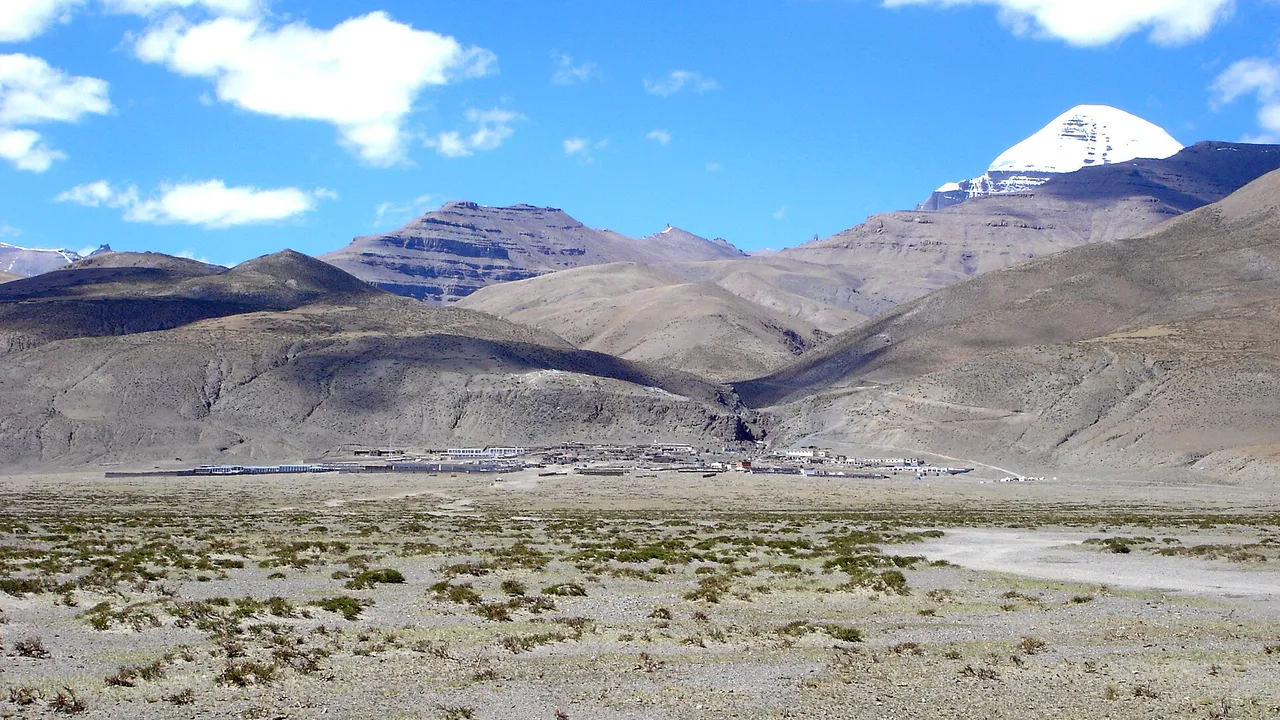
Day one's dusk goes to the town-edge open ground: Kailash's west wall runs white to gold to red as the sun drops, and the kora start's flags ignite in the same light. This is your first formal meeting with the peak; tomorrow and the day after it will appear in different roles.
Stay past sunset for the blue hour, when the plateau sky's bands run finest. Then dinner, a foot soak, early sleep, and the first 4,700-meter night handed over to rest.
The Manasarovar Circumambulation Stretch: A Day with the Sacred Lake
Day two charters to the sacred lake for a short clockwise stretch of the circumambulation path. The full circuit takes days; three to five kilometers suffices for travelers: the water's banded blues, Naimona'nyi far off, mani piles and flags along the way, the complete definition of a Tibetan pure land.
Sit lakeside on packed rations and watch pilgrims prostrate full-length or three-steps-one-bow. Today you do not hurry, and the lake does not hurry you. Drop the tempo to its floor; the sacred lake's blue needs time to develop in the eyes.
Rakshastal: The Ghost Lake and Afternoon Light
Shift after lunch to Rakshastal, one road away. Afternoon light gives the lead-gray surface a metallic grain, set against the sacred lake's blue under the same sky. Visitor density here runs far below the sacred lake's, suiting forty quiet minutes.
The road between the lakes is itself a viewpoint: look left and right, one pure and one turbid, one blue and one gray, a few hundred meters apart. This geographic drama belongs to Pulan alone.
Lakeside Pastures and Herding Households: An Hour on the Plateau Range
Stop at a lakeside pasture on the way back to Tarchen: in summer, yaks and sheep scatter the range and smoke rises from herders' tents. Watch range life from a distance for an hour, no intrusion, no nearing tents, no chasing animals for photos.
If you pause at a household for yogurt or curds, let price and conversation float free, and if declined, leave smiling. Rural courtesy is lightness: a nod, a smile, no trespass.
Tarchen Tibetan Eatery: The Country Day's Closing Dinner
Back in town for dinner at day one's eatery, where the owner likely remembers your order. The hidden dividend of three country days is repetition: the same teahouse, the same eatery, the same street, everything one layer more familiar than the day before.
Early to bed after. Tomorrow's task is light, yet the afternoon viewpoint sits at 4,700 m, so the morning's sleep and condition still matter. Check battery and card space before sleep; tomorrow afternoon's shutter will work harder than the previous two days'.
Kora Starting Section: The Third Perspective
Day three's morning walks the kora start once more. After two days steeped in town you recognize pilgrims' faces now: pre-departure tension, the looseness of return, and the audienceless gaze of full prostrators. This observation now carries two days of footnotes.
Walk two kilometers up the start and turn back, feeling the kora trail's texture. You need not finish fifty-two kilometers, but the first step of understanding it is worth taking.
Mount Kailash Viewpoint: The Three-Day Close
Day three's afternoon goes straight to the viewpoint. By now the relationship has changed: you know which direction the wind comes from, how the teahouse talks about the peak, who tends its flags. The mountain is the same mountain, but your gaze now holds three days of living.
Sit until the light chills and fold the three days together in your head. Back in town, settle with the driver and confirm your transfer; the country line closes on one complete act of gazing.
| Getting around |
|
| Budget | Three-day charter shares, lodging and meals total roughly RMB 1,200-2,200 pp, with tea and lakeside fees a minor slice. |
| Best time | May-June and September-October are best, with pastures greening or golden and pilgrims streaming past; July-August grays the lakes without dulling the teahouses and human scenes. |
FAQs
Does skipping the kora waste Mount Kailash across three days?
Not, depending on why you came: the kora is the body's practice, the country line the understanding's. Three days lodge you inside the kora ecosystem entire, and the Kailash you see may be rounder than the rushed two-day walker's. Short on fitness or time, this is a wholly respectable choice.
Better to see both lakes in one day or split them?
The country line splits them on purpose: the sacred lake on the adaptation day, the ghost lake with pastures the next, the rhythm loose. Time-pressed travelers can do both lakes plus the viewpoint in one day, but every stop compresses to twenty minutes and the lakes' slow nature switches off. Choose the split unless your timetable is not your own.
May I approach herders' tents at the pastures?
Stop, watch, then decide: with dogs at the tent and signs of avoiding strangers, keep your distance; invited inside is the rare case, hat off, clockwise, never on the threshold, both hands steadying the bowl when the hostess pours. Always ask before photos, expect refusals at a real rate, and accept them.
Where are the altitude-risk points in the three days?
They concentrate in two places: the first Tarchen night at 4,700 m and the afternoon viewpoint near 4,700 m. The counters are zero climbing on day one and a retreat to the county town near 3,900 m to sleep whenever headache worsens beyond two hours, plus time-capped, slow-motion viewpoint stops. The three-day plan's edge is that descent is always available, so use it without embarrassment.