
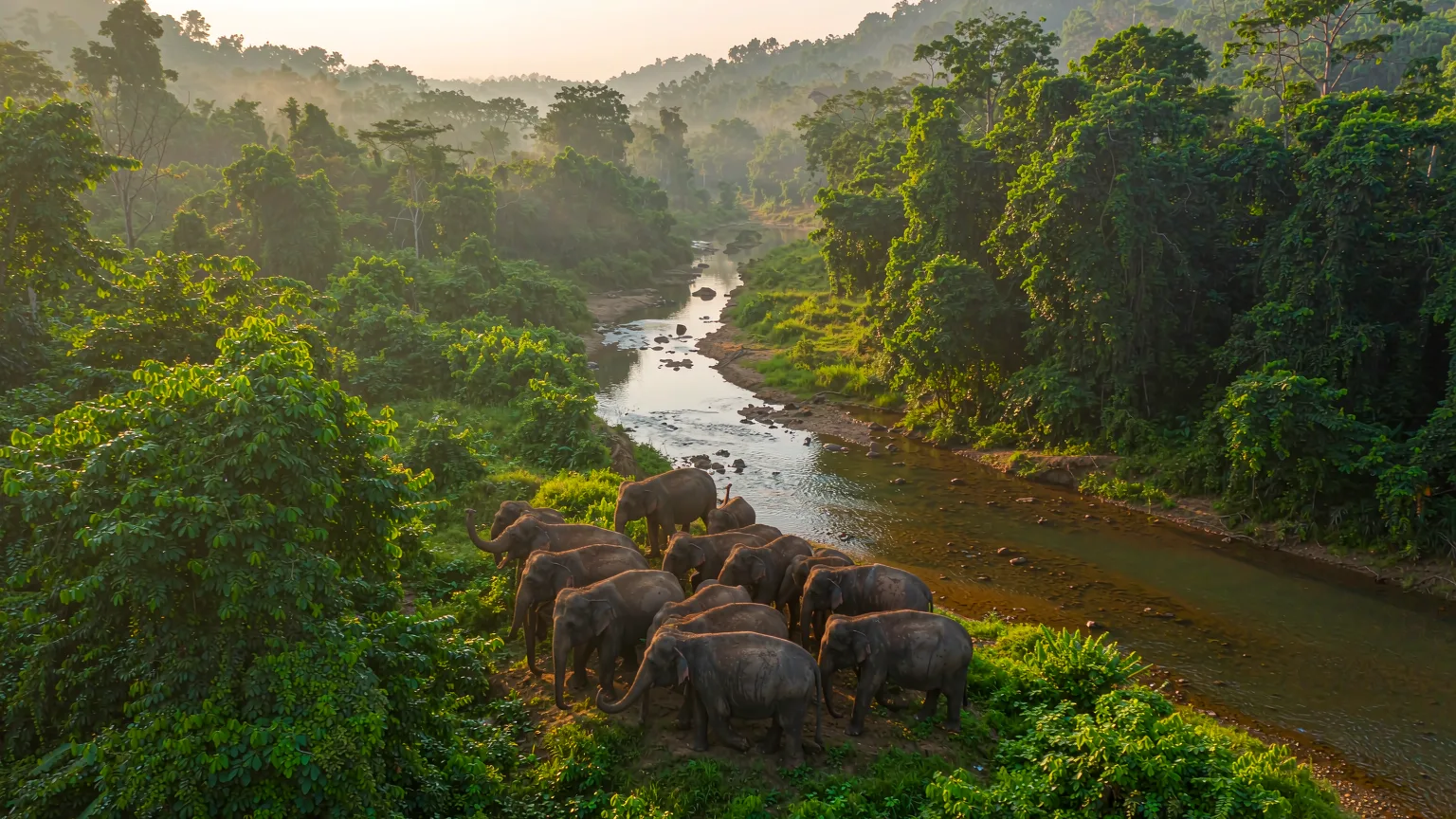
Banna's nature line holds three aces: the Asian elephants of Wild Elephant Valley, the species density of the botanical garden, and the rainforest giants of Wangtianshu. Each ace gets a full day, with the first two nights back in Jinghong and the third in Mengla or returning there, a simple physical structure that stays unexhausting.
Distances between the three run one to two hours by road with patchy public transport, so shared or hired cars link them best. The rainy season needs slack: the canopy walk and trails weather badly, so keep the garden, with its glasshouses and shaded paths, as the rain plan, and swap the order freely.
Itinerary at a glance
| D1 08:30 | Wild Elephant Valley: Raised Walkways and Elephant Country |
| D1 14:00 | Jinuo Mountain Village: Ethnography in the Rainforest |
| D1 16:30 | Xishuangbanna Primitive Forest Park: The Peacock Flights |
| D2 08:30 | The CAS Tropical Botanical Garden, West Section: A Flood of Species |
| D2 14:00 | The CAS Tropical Botanical Garden, East Section: The Green Stone Forest and Gully Rainforest |
| D2 19:30 | Night Walk in the Garden (Optional): The Rainforest's Night Shift |
| D3 08:30 | Wangtianshu Scenic Area: Seventy-Meter Giants of the Rainforest |
| D3 13:30 | The Nanla River Boat: The Rainforest from Water Level |
| D3 17:30 | The Xishuangbanna Tropical Flower Garden: A Return-Day Buffer |
The route, stop by stop
Wild Elephant Valley: Raised Walkways and Elephant Country
Open the nature run at Wild Elephant Valley on the 8:30 first entry. The raised corridor stretches over two kilometers at canopy height above gully rainforest, with dawn the peak window for herds at the salt licks, ten minutes held quietly at each observation point, silence the first rule.
Beyond elephants, the walkway is a living textbook of rainforest structure: buttress roots, stranglers, cauliflory and lianas woven together. The on-site museum supplies the Asian elephant background that underwrites the next two days.
Jinuo Mountain Village: Ethnography in the Rainforest
The Jinuo, formally recognized as China's 56th people only in 1979, live clustered in the Jinuo hills east of Jinghong. The village site pairs a guided walk with a performance explaining the drum legend, dress and food, its forest-and-tea trail complementing the morning's botany with the human layer.
The Jinuo hills also rank among the ancient Six Great Tea Mountains, and the tea plots around the site merit a passing look. Performances run to a fixed schedule, so confirm times at the gate and fit the walk before or after.
Xishuangbanna Primitive Forest Park: The Peacock Flights
An easy add-on on the route back from the Jinuo hills, skippable under time pressure. The peacock flights are the park's signature, hundreds of birds gliding down the ridge in several daily sessions, while the gully trail and the Aini village complete the ethnographic and botanical threads.
Lighter than the elephant valley, two or three hours fits. By dusk you are back in Jinghong for Gaozhuang's first appearance, the city and the forest splitting day one evenly.
The CAS Tropical Botanical Garden, West Section: A Flood of Species
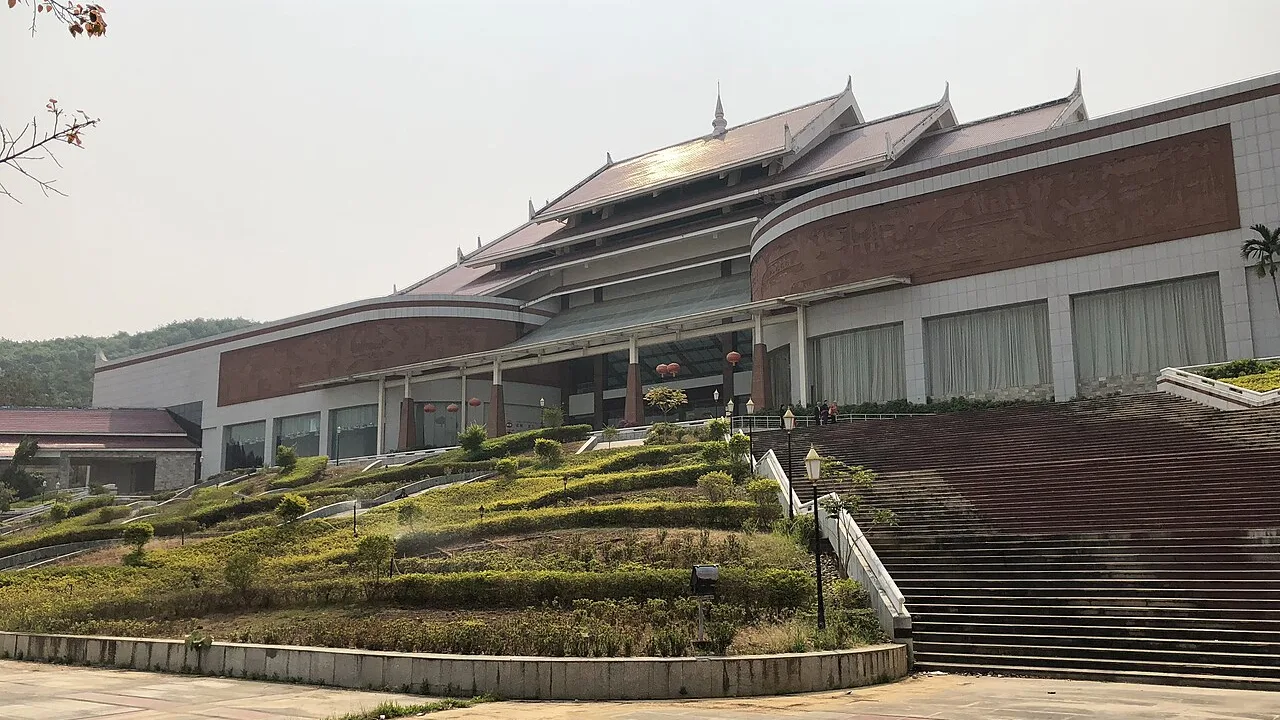
The garden sits at Menglun, about an hour from Jinghong. The west section is the classic: giant floating leaves at the giant-water-lily pool, the dancing plant of the oddities garden, palms and figs, and covering a third of it in a morning is ambition enough, with electric carts stopping at every garden gate.
The botanically unversed should beeline three spots: the giant lilies, the oddities garden, and the notable-trees garden. Take a guide or audio device, since names and stories are this place's core asset, and unguided it reads as very expensive landscaping.
The CAS Tropical Botanical Garden, East Section: The Green Stone Forest and Gully Rainforest
The east section is the garden's wild face: the Green Stone Forest draped in lianas and trees, stone and forest grown into one body, and the gully rainforest path following a tributary of the Luosuo River, where buttress roots and stranglers run denser than in the west.
The east costs more legs, with real climbing in the stone forest, so choose lines by fitness, since carts stop at the entrance only. After 4 pm, watch the sunset by the Luosuo near the exit, the river-rainforest boundary the garden's finest closing frame.
Night Walk in the Garden (Optional): The Rainforest's Night Shift
The garden's night walks run with a guide and torches, finding nocturnal animals and luminous plants, stick insects, frogs, night insects and owls, the whole daytime-hidden system clocking in after dark, and children usually react hardest to this hour.
Night walks need advance booking with limited sessions, and sleeping at Menglun makes them easiest; returning to Jinghong afterward lands late, so push day three's departure accordingly.
Wangtianshu Scenic Area: Seventy-Meter Giants of the Rainforest
The wangtianshu is a dipterocarp giant, mature trees reaching seventy or eighty meters, the very signature proving tropical rainforest exists here. The aerial walkway hangs tens of meters up between crowns, swaying gently, the forest's strata unfolding below, canopy, understory, floor, all at once.
The height-averse take the ground-level gully trail, where the view upward stuns all the same. The walkway caps numbers in batches and queues in season, so line up for it on arrival, then do the trail.
The Nanla River Boat: The Rainforest from Water Level
After the canopy, read the forest once more from the water. The Nanla's in-park stretch runs calm, the boat tracing the rainforest banks, the walkway teaching vertical strata and the boat teaching the boundary where forest meets water.
Half an hour aboard, the right pace for the afternoon. After landing, point the car toward Jinghong and spend the three-hour drive on a nap.
The Xishuangbanna Tropical Flower Garden: A Return-Day Buffer
Back in Jinghong with energy left, the Tropical Flower Garden closes lightly: a themed garden of tropical blooms and crops, frangipani, white champak and coffee trees settled in residence, one easy hour to digest three days.
The light softens toward evening and entry stays cheap, the right place to land three days of nature before a Dai dinner closes the line.
| Getting around |
|
| Budget | Entries total about RMB 300-400 with the botanical garden pass and the Wangtianshu canopy walk extra, car share across three days RMB 400-600; with food and lodging the trip runs RMB 1500-2200 pp. |
| Best time | November to April is the comfortable dry season; the rains bring the greenest forest but afternoon showers, and the canopy walk closes in rain. |
FAQs
Can the botanical garden fit one day? Should I overnight at Menglun?
No, and you need not: west half-day plus east half-day is the sane ratio, with Menglun lodging paying off through the night walk and a carless morning. If Jinghong calls you back, cut to west only, or highlights of both, any trim works, so do not force the full circuit.
Is Wangtianshu worth a dedicated three-hour drive?
For rainforest devotees, yes, the canopy walk being unique in the country. If time is tight or trails leave you cold, the garden's Green Stone Forest and gully rainforest deliver eighty percent of the experience, and the drive can be dropped. The test is whether walking the canopy is a must for you.
What are the odds of seeing wild elephants across three days?
The odds live only on day one, usually twenty to thirty percent on dry-season mornings and lower in the rains. The healthy setup front-loads the certain: forest, garden, giants are all certain, while elephants are the bonus. The park's rescued elephants guarantee a close look as the floor.
How should the three days be sequenced in the rainy season?
Keep the weather-toughest option movable: day one at the valley, whose mornings usually hold, day two swapping the garden and Wangtianshu by forecast, day three buffered for the return. Set each day's main event after the morning forecast; rainy-season showers favor afternoons, making mornings the whole trip's most reliable hours.